

The Birthday That Started All This
My niece Zara — nine, nearly, boss of any room she walks into — got her coeliac diagnosis two weeks before her birthday. Two weeks. Party planned, friends invited, banner bought (pink, obviously), and she sat at my kitchen table doing that brave not-crying face kids do and said, so I just don’t get a cake then?
No. Absolutely not, not in this house, not on my watch. The first version I made her was, hmm. Fine. Edible, technically, dry round the edges, a bit apologetic-looking, and she was so polite about it — it’s nice, khala — which made it ten times worse.
So I spent the next year fixing it, one birthday, one just-practising-eat-this-and-tell-me-the-truth slice at a time, until I landed on this cake — the one where her friends asked for seconds, one asked for the recipe for her mum, and not one person said those dreaded words, good for a gluten free cake.
That’s the bar now. Not good-for-gluten-free, just good, full stop. Right, here’s the thing itself.
What Goes In It
Two 8-inch round layers, that’s the shape of it, and get everything to room temperature if you can — cold eggs and cold milk make the batter sulk. Eggs go in warm tap water while I faff around finding the pans, works fine, don’t tell the food safety police.
- 1 ¾ cups (about 245 g) 1:1 gluten free flour blend, one with xanthan gum in it
- 2 cups granulated sugar
- ¾ cup unsweetened cocoa powder — Dutch-processed if you have it, natural works too
- 2 teaspoons baking soda
- 1 teaspoon baking powder
- 1 teaspoon fine salt
- 2 large eggs, room temperature
- 1 cup milk (whole milk is best here; dairy-free milk also works)
- ½ cup neutral oil — sunflower or light olive oil
- 2 teaspoons vanilla extract — the real bottle if you’ve got it, the cheap one if you haven’t, 2 teaspoons either way, nobody at a birthday party has ever once detected the difference
- 1 cup hot strong coffee (or hot water, but — and I say this with love — read the note in step 3 before you swap, don’t just swap it and hope for the best)
For the frosting: ¾ cup soft butter — soft soft, room-temperature soft, the leave-it-out-on-the-counter kind, not the melted-in-a-panic-in-the-microwave kind, that way lies greasy frosting — 3 ½ cups powdered sugar, ½ cup cocoa powder, ⅓ cup milk, 1 teaspoon vanilla, and a pinch of salt, and yes the pinch matters, skip it and the whole frosting tastes oddly flat and you’ll stand there wondering what’s missing, it’s the pinch, it’s always the pinch.
And listen, one grumble before we even start, because somebody always, always tries it: do not go halving the sugar thinking you’re being clever and sensible about it. I did. Batch three. I was so pleased with myself right up until it came out of the oven dense as an actual house brick, doorstop cake, we ate it out of politeness, dunked in tea. Sugar in this cake is not just there for sweetness, it’s doing a job, it’s structure, it’s holding the whole thing up — leave it alone.
Let’s Bake the Thing
Step 1 — Pans first, always
Oven on first, before your hands get cocoa’d, 350°F (175°C), grease two 8-inch round pans and line the bottoms with parchment circles — trace round the pan, cut inside the line, ten seconds, done. Mine come out wonky, egg-shaped, nobody inspects cake bottoms anyway.
Baker’s note: gluten free cakes cling to pans like they’ve signed a lease, much worse than wheat ones. The parchment circle is not decoration, it’s insurance — trace it, cut it, thank yourself later when the layers drop out instead of coming away in tragic chunks.
Step 2 — The dry bowl
Big bowl — the biggest one you’ve got, you need elbow room for this, the medium one will betray you — and in goes everything dry in one unceremonious heap: the flour, the sugar, the cocoa, the baking soda, the baking powder and the salt, no order, no layering, just dump, and then you whisk it, and I mean actually whisk it, like you mean it, two hands nearly, not that lazy half-hearted swirl round with a spoon I did the first time and thought, eh, close enough. It was not close enough. Cocoa hides in lumps, it is sneaky stuff, and somewhere in that bowl, guaranteed, there’s a little lump of baking soda sitting there waiting to ambush one unlucky slice — soapy, fizzy, horrible surprise, mouthful of washing-up — and the birthday girl got that bite once, once, and she has not forgotten, she brings it up every single year. So whisk until the whole bowl is one even brown powder, no pale streaks sulking anywhere, dig right into the corners, that’s where the lumps live.
Step 3 — Wet in, then the hot coffee
Now the wet stuff lands on top of the dry in a gluggy heap — eggs, milk, oil, vanilla, all of it in together — and you beat the whole lot on medium for about 2 minutes, timer-ish, no laboratory precision needed, nobody is standing over you with a stopwatch and a clipboard. And it comes together looking nice and normal and well-behaved, thick like cake batter in a telly advert, and you’ll think lovely, done — and then you stir in the hot coffee and the whole thing just… changes its mind about being batter. Everything changes. Keep going anyway.
Baker’s note: the batter is now shockingly thin. Soup thin, wrong-looking thin — do not panic and do NOT add flour, I am begging you, because that exact panic, me going this can’t be right and tipping in extra flour, is what ruined batch number two. Thin batter is the entire reason this cake is moist instead of dry. And the coffee — no, you won’t taste it, not even slightly, it just makes the chocolate taste more like itself somehow, and if coffee is a problem then hot water works, but coffee is better.
Step 4 — Bake
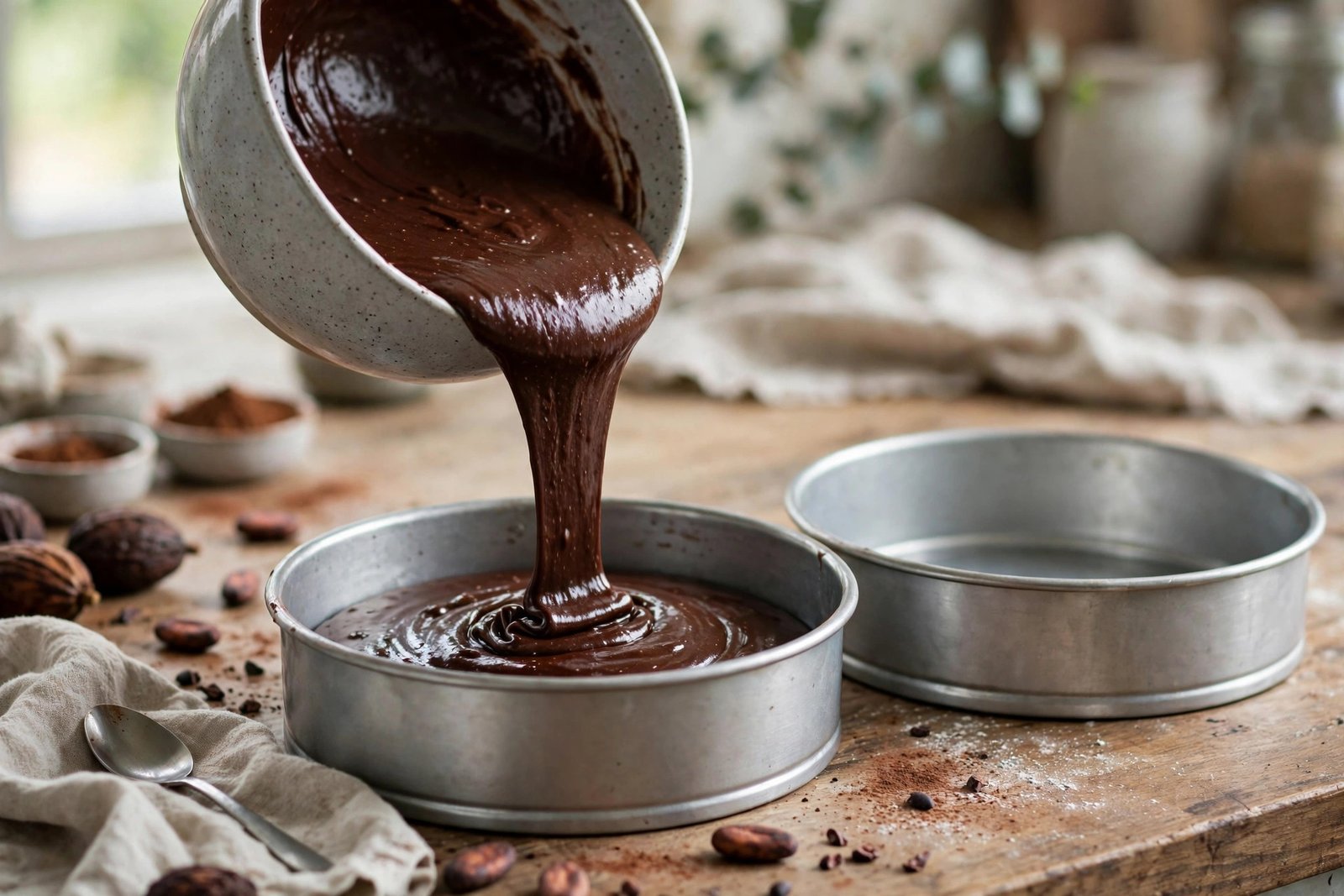
Right, batter’s soup, we’ve made our peace with the soup, now it goes into the pans and even this bit I have managed to disgrace myself at, so learn from my file of errors: a bit in one pan, a bit in the other, back, forth, back, forth, like dealing cards to two very patient players, because if you dump the lot into one and then go oh no and try to redistribute it with a spatula halfway — ask me how I know, actually don’t, there’s a scar and a story and we’re not doing the story today. They’ll sit about two-thirds full. Roughly even. Roughly is carrying a lot of weight in that sentence and that’s fine, perfect doesn’t live in this kitchen, perfect has never even been sent the address.
In they go, 30 to 35 minutes, door shut — and now walk away. Walk. Away. Do not stand there lurking at the little glass window with your phone torch pressed up to it like it’s a cinema for ants. I lurk. I am working on the lurking. We are all works in progress.
And done — done is a look, learn the look, it’s worth more than a timer: toothpick, straight into the centre, and what you want clinging to it when it comes out is a few moist crumbs. Crumbs. Holding on for dear life. Not wet batter — wet batter means it is NOT done, back it goes, five more minutes, no sulking, no ‘but it looked done’, it wasn’t. And give the top a gentle poke with a fingertip while you’re there: it should spring straight back up like you’ve mildly offended it. A dent that stays? Not done either. That one sentence — crumbs good, batter bad — has saved more of my cakes than every gadget in my drawers put together.
Step 5 — The cooling rules
Out they come, and now we arrive at the section of this recipe I am, historically, the absolute worst at: doing nothing. They sit in their pans for 10 minutes. That’s the rule. Ten. Set a timer — an actual timer, a beeping one, because my unsupervised ‘about ten minutes’ involves answering one message, then another message, then suddenly it’s twenty-five and the layers have been sitting there in warm pans steaming their own bottoms. Because that’s what happens, that’s the science of my carelessness: gluten free layers left lazing in a warm pan sog out underneath, steamed, damp little floors under an otherwise respectable cake, and nobody in the history of cake has taken a bite and gone mmm, steamed bottom.
Timer goes — out. Onto the racks. And then: cold. Completely cold. Not warmish, not ‘probably fine’, not that thing where you hold your palm near it and go eh, close enough — cold, properly, all the way through, however long your kitchen takes about it, because warm layer plus frosting is not a cake, it’s an incident. A landslide. Chocolate, sliding, sideways, in awful slow motion, while you stand there holding a knife like a witness at the scene. I can still see that day in high definition and the star of it is the dog, who had positioned himself under the table with the instincts of a professional, and he remains to this day the only attendee who truly enjoyed that cake. Frost a cold cake. Waiting is boring. Wait anyway.
Step 6 — Frost like you mean it
Butter. Just the butter, alone in the bowl, nothing else invited yet, and you beat it — and beat it — until it goes pale and soft and properly fluffy-looking, and whatever moment arrives where you think right, that’ll do, ignore that moment, it’s a liar, keep going. Everyone stops this bit too early. I stopped too early for the better part of a year. It’s practically a personality trait at this point. Pale, soft, fluffy — THEN you may proceed.
Sugar and cocoa next, and they go in a cup at a time. A cup. Beat. A cup. Beat. This is not me being precious about it, this is me having — twice, TWICE — tipped the whole lot in at once like a woman with somewhere to be, and created a sweet white weather event in my own kitchen: dust on the cupboards, dust on the counters, dust on me, a faint outline of myself in frosting dust like a crime scene. Zara still refers to it as the snow cake that never was. Cup at a time. Splashes of the milk in as you go to loosen it when it gets stiff and grumpy, and the vanilla and the pinch of salt ride in at the end like they planned the whole thing. Beat it until it’s fluffy and holds a swoop and you’re standing there a bit pleased with yourself, which you are allowed to be.
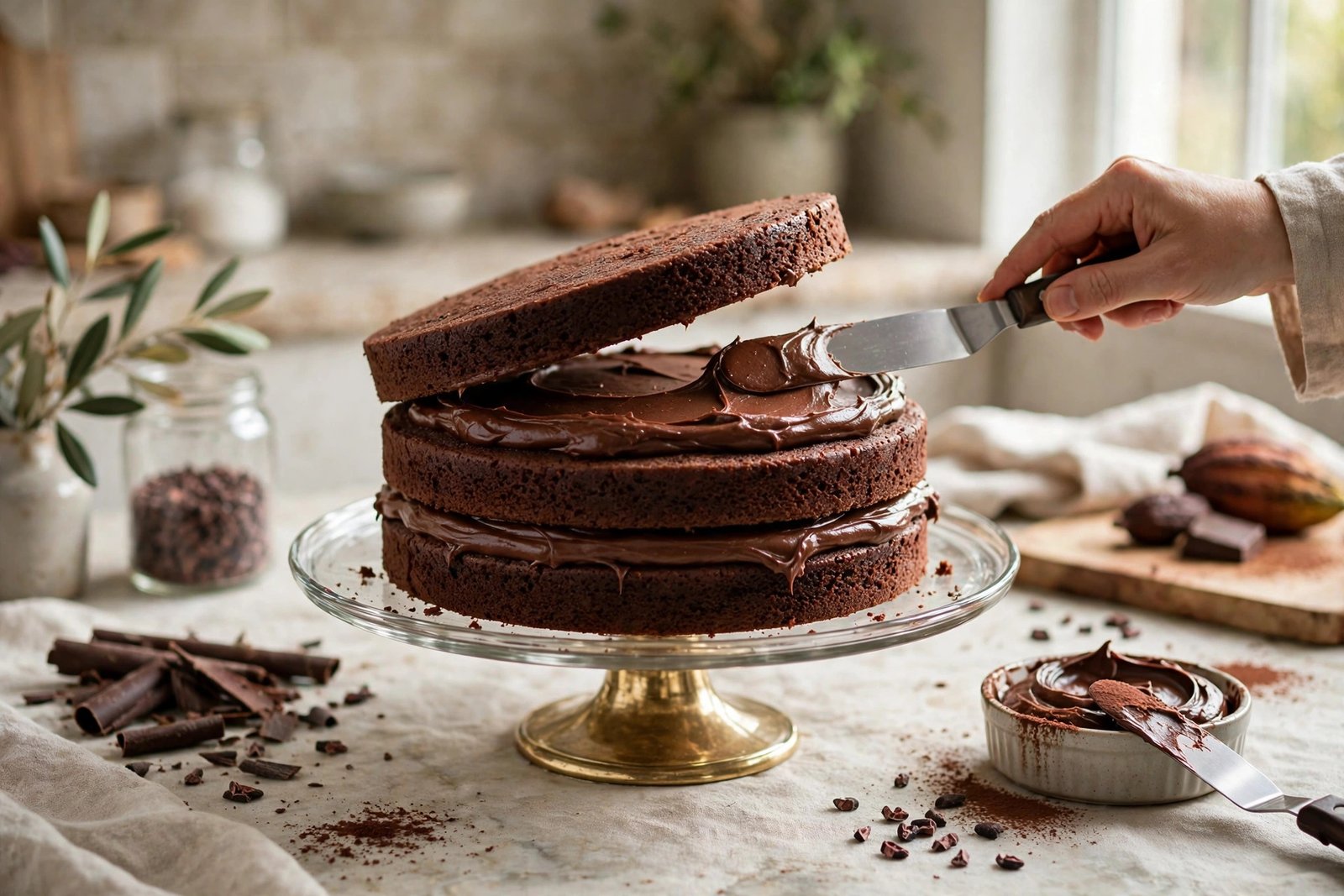
Then stack it, fill it, frost it — and stop. I am begging you, from my heart, stop trying to get it smooth like a shop cake, that way lies forty extra minutes and a small breakdown. Back of a spoon. Big deliberate swirls, all over it, swoop swoop swoop, and every wobble, every uneven patch, every place a crumb tried to escape through the frosting just… disappears under a swirl. It looks deliberate. It looks like you meant every bit of it. You did mean it. That’s the whole trick, it’s ninety seconds long, and it has never once not worked.
The Bits People Get Wrong
Dry cake: overbaked. That’s — look, nine times out of ten it’s just overbaked, the poor thing sat in the oven being cooked well past its moment while somebody somewhere trusted a timer over a toothpick, which is a mistake with a long and dishonourable history in this kitchen. The other culprit is sneakier: flour measured by driving the measuring cup straight through the bag like a snowplough, which packs in far, far more flour than this recipe ever asked for and then everyone blames the recipe. Spoon the flour into the cup. Level it off with a knife. Or — and this is my actual answer now, after years of dry-cake archaeology — weigh it. 245 g. On the scales. Done. No arguments, no snowploughs, no mysteries.
Cake sank in the middle: somebody opened the oven in the first 20 minutes. Was it you? It was you, wasn’t it. It’s always a peek — one little peek, ‘just checking’, barely even a crack of the door — and a gluten free cake has maybe half the structure of a normal cake so it forgives you about half as much, which is a polite way of saying the middle drops, sulks, and sits there sunken while you explain yourself to it. The other suspect, when there genuinely wasn’t a peek, honest, is the baking soda: the tub that’s been open at the back of the cupboard since roughly the invention of the cupboard, old, tired, completely done with rising anything. Door shut. Fresh soda. That is most of the whole mystery solved, I promise you — it’s rarely anything more sinister than a peek and an elderly tub.
Grainy texture: this one, nice change, is sometimes not even your fault — the cheaper rice-heavy blends can bake up gritty entirely on their own, it’s in their nature, it’s simply who they are as a flour. But there is one small thing that helps far more than it has any right to: rest the batter. Ten minutes, sitting in the bowl doing nothing, before it goes anywhere near the pans, so the flours get a chance to actually drink and hydrate instead of being rushed into a hot oven thirsty and unprepared. I laughed at that tip the first time somebody gave it to me. Laughed. Then I baked two cakes side by side, rested and unrested, like a woman conducting an experiment in a laboratory instead of a kitchen with a cat in it. Visible difference. An actual, point-at-it visible difference. Rest the batter.
Making It Ahead (Because Parties Are Chaos Enough)
Party day in this house is chaos — there are balloons in the sink, nobody can find the tape, the tape is in a drawer everybody has already looked in twice, and somebody is always, always being sent back out for ice — so hear me when I tell you the layers are your friend here: they bake beautifully a day early. A whole day. Cool them properly (see above, the waiting, I know, I’m sorry), wrap them tight, leave them at room temperature, and then do not think about them again until the day itself, when you stroll in and frost them like a woman who has her entire life together. Nobody at the party will know. I have done this in front of witnesses and the witnesses asked for the recipe.
Freezer works too, before you ask: wrapped layers, up to a month in there, genuinely fine, and then thaw them out on the counter while you make the frosting — they defrost at almost exactly frosting-making speed, as if the two things had a meeting and planned it. They did not. It just works out that way and I have decided to be grateful instead of suspicious.
And the finished thing — frosted, swirled, admired — keeps 3 days in a covered container at room temperature, longer in the fridge, no drama, no decline, it just sits there being cake. But. And this is the bit that catches people out and then they message me about it. If it has been in the fridge, you drag it out 30 minutes before serving. Thirty minutes. On the counter. Because cold cake eats like a brick — dense, heavy, sad, bearing almost no resemblance to itself — and you will stand there with a fork thinking you’ve somehow lost your touch since yesterday, when in fact your cake is simply chilly and needs half an hour to remember who it is. Half an hour on the counter and it’s back: soft, dark, itself again. The cake was never the problem. The temperature was the problem. It usually is.

Small Swaps That Work
No 1:1 blend in the shops near you? Been there. The shop near me stocks it faithfully right up until the week I need it, it’s like it can smell a birthday. A mix of rice flour and tapioca starch with a spoonful of potato starch stirred in gets you close — properly close, closer than you’d think — just go in knowing the crumb comes out a bit more delicate, a carry-it-with-two-hands, treat-it-like-it’s-precious situation. Fine for a birthday. Just don’t go throwing it around the kitchen like a wheat cake, it has not signed up for that.
Dairy-free works as well: milk out, oat milk or soy milk in, no ceremony, no adjustment, it just gets on with it. The frosting is where you have to pay attention, though — the butter swaps for a firm dairy-free baking block, and I need you to actually hear the word firm, lean in for it, because the soft tub spread stuff will betray you so completely and so publicly: it makes frosting that weeps and slides, there will be a chocolate puddle incident, people will be kind about it in that awful quiet way, ask me how I — no. No, we’re not doing that story either. Buy the block.
And if you want it darker — fudgier, moodier, more of an evening cake — the trick is insultingly simple: trade a quarter cup of the flour for extra cocoa, take the sugar down by two tablespoons to keep it honest, and change absolutely nothing else. That’s it. That’s the whole recipe edit, I kept waiting for a catch and there isn’t one. What comes out leans brownie, leans cake, camps out somewhere dense and dark in between the two and refuses to apologise, and the complaint count on that version, so far, across multiple birthdays and one extremely honest family, is zero. Zara has opinions about it. Zara has opinions about everything, it’s her whole thing. She approved. Eventually. Out loud, which for Zara is basically a certificate.
Leftovers? Bold of You to Assume
But if there are — stranger things have happened, once — slices freeze individually, wrapped, for about a month. A frozen slice in a lunchbox thaws by noon all on its own, which has made me briefly popular at more than one office.
Zara is older now. She still requests this exact cake, and I think she’d riot if I changed a single thing about it. The friends who asked for seconds that day never did find out — well, until one of them reads this, I suppose. Hi. It was gluten free all along.
