
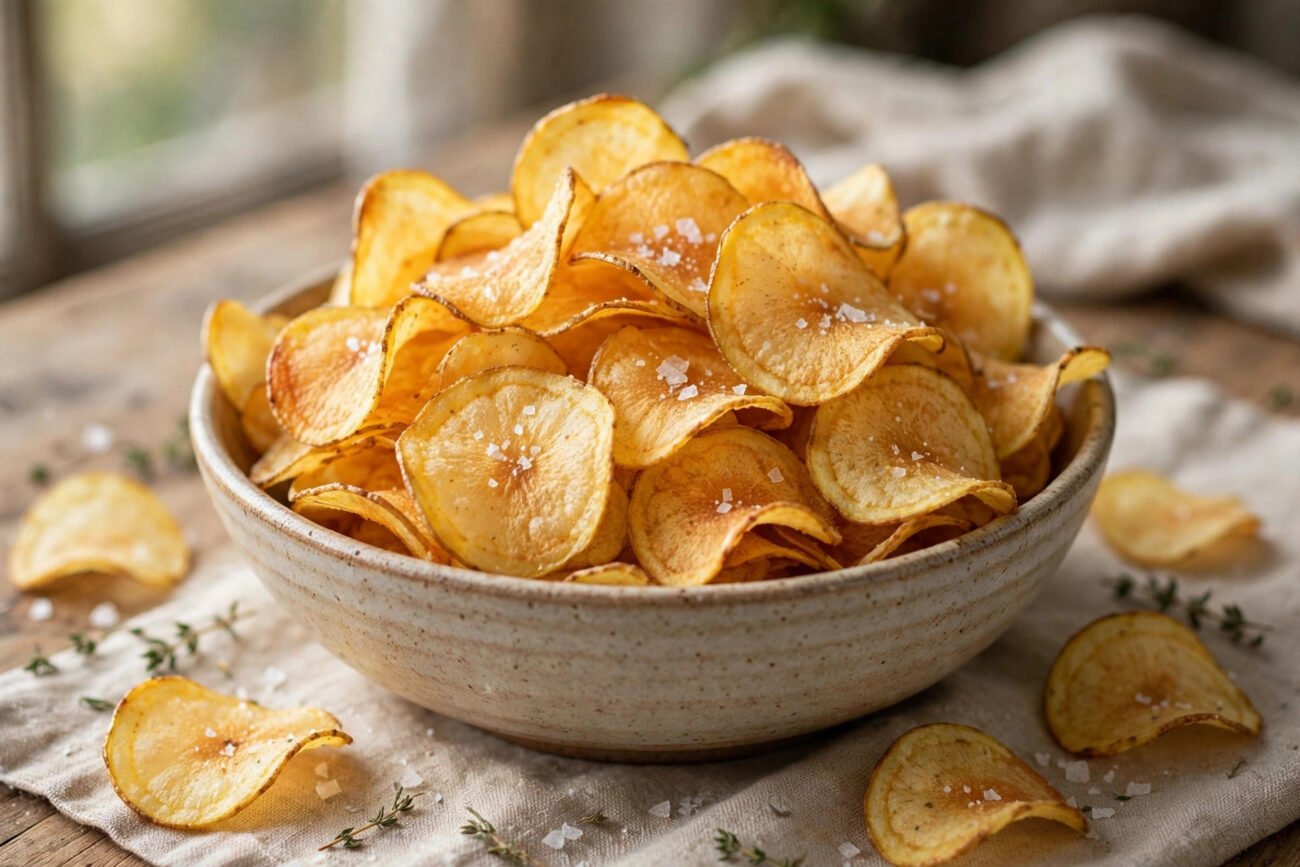
Batch number one of these, in my kitchen, was a disgrace. Not the forgivable kind either. Not learning-curve, bless-him-for-trying stuff — the full production. Singed black in the centre. Raw round the edges. And a few overachievers in there managing both at the same time, which takes talent, in a way. I ate the least-burnt ones standing over the sink and called them rustic, because that’s the word you reach for when it’s gone wrong, you’ve already made it, and your pride won’t let you say so.
The problem was not the air fryer. I blamed the air fryer for about a week. The problem was me, slicing potatoes with a knife at whatever thickness my hand felt like, then flinging them in wet. Once I fixed two things — slice them thin and even, and soak the starch off — these went from embarrassing to the most requested snack in my house. A bag of chips from the shop does not really get opened anymore.
They are not identical to deep-fried chips, let me say that up front. They are lighter, a bit more potato-y, and you can taste the potato instead of just the oil. Most days I prefer them.
Why You’ll Love This Recipe
One big potato makes a surprisingly full bowl of chips, which makes this a very cheap snack for something that feels like a treat. There is no pot of oil to deal with, no splattering, no standing over a fryer, and no oily smell in the curtains the next day.
You also control everything. The salt level, the thickness, the seasoning, how dark they go — all of it, yours, no committee involved, no bag deciding for you. My daughter likes them pale and salty, barely-kissed-by-heat salty, and I like them deep golden, nearly too far, walking right up to the edge of burnt and waving at it, so we do two batches and everybody is happy — everybody, that is, except the person washing the mandoline afterwards, and that person, every single time, is me.
Ingredients
- 2 large russet potatoes (about 1 lb / 450 g total) — russets, specifically, and there’s a reason, it’s right after the list
- 1 to 2 teaspoons neutral oil (avocado oil or light olive oil) — barely any, don’t panic, it’s plenty
- 1/2 teaspoon fine sea salt, plus a little more for finishing — most of the salt action happens at the end
- Optional: 1/4 teaspoon garlic powder, smoked paprika, or black pepper — dealer’s choice, all three work
That is genuinely it. Russets are the potato for this — they are starchy and dry-fleshed, so they crisp instead of going leathery. Waxy potatoes like red ones will cook, but they never quite get to that snap, and the snap is the entire project here.
Step-by-Step Instructions — Batches, Patience, and Not Walking Away at the End
- Scrub the potatoes well. Peel them or don’t — I leave the skins on about half the time because I like the edges, but peeled gives a more classic chip, and nobody is checking either way — there is no peel police, no potato inspector calling round.
- Slice them thin and even — 1/16 inch, about 1.5 mm, thinner than feels sensible — because a mandoline is honestly the best tool here, it just is: it’s the difference between chips that cook evenly, all marching along at the same pace like a team, and chips that fight you slice by slice. If you only have a knife, fine, knives work, plenty of people manage — just go slow and aim for slices you can almost see light through, the kind you hold up to the window like you’re checking a banknote. Watch your fingers on the mandoline. Use the guard. I say this as someone who learned.
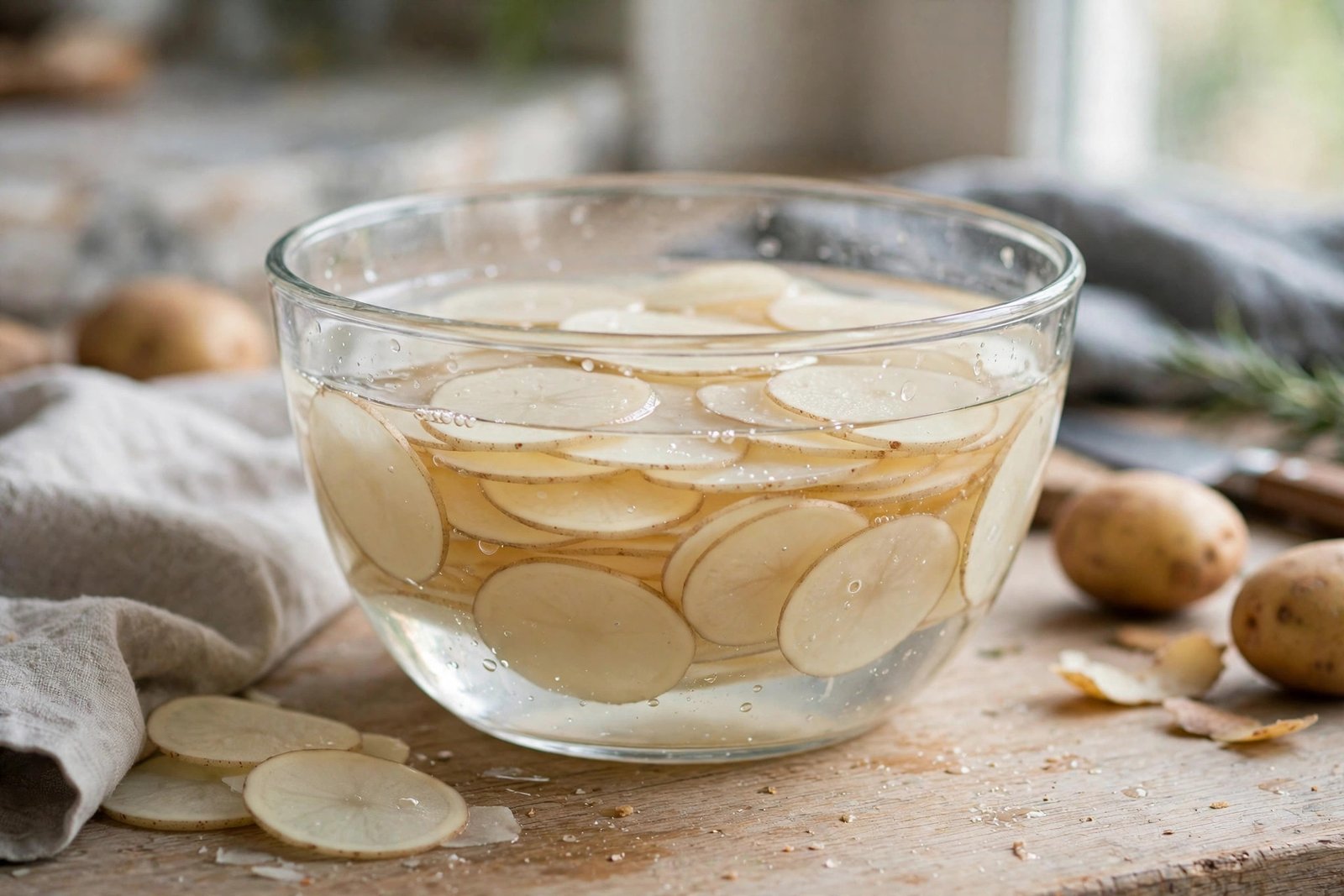
- Put the slices in a big bowl of cold water and soak for 30 minutes — and don’t skip this, don’t even look at me like that, because this is the step, the actual step, that pulls the surface starch off them, and surface starch is the whole difference between crisp and gummy, between a chip and a sad little potato coaster. If the water goes very cloudy, change it once halfway.
- Drain the slices and dry them like it matters, because it does. A salad spinner first, if you have one — give them a proper whirl, get the worst of the water off — then spread them out on a clean tea towel or paper towels and pat the tops down thoroughly, like you’re tucking them in for a nap they will not be waking up from. Any water left on them will steam in the air fryer and steam is the enemy of crunch.
- Tip the dry slices into a bowl, drizzle the oil over and toss the whole lot with your hands — hands, not a spoon, you want to feel what’s happening — so every slice gets a whisper of oil on it, just a whisper, we’re not deep-frying here. Season now, or salt at the end, your call entirely: I do a tiny bit before and the rest after cooking, when it sticks to the hot surface and actually stays where it’s put.
- Air fryer on first — give it 3 minutes at 350°F (175°C) to get itself hot before anything goes near it.
- Into the basket they go flat, side by side, one layer, that’s it. No overlaps. No shingling them up like roof tiles. Every slice gets a bit of air around it, a bit of room to breathe. Which means — yes — batches. Plural. Worth it though, completely worth it. Cram them in piled up and the ones at the bottom don’t fry, they steam, trapped down there sweating away with nowhere for it to go, and you’ll be fishing soft ones out afterwards like some disappointed archaeologist, brushing bits off, sighing down into the basket at your own choices.
- They get 12 to 16 minutes in there. Halfway through — shake the basket, or flip the slices over one by one if you’re feeling thorough. But minute 10, that’s when you start watching. Properly watching, not wandering off, because the finish comes at you fast, and I mean fast — look-away-to-put-the-kettle-on fast — so any slice that’s already golden and crisp, get it out, rescued, done, and the pale ones can carry on without it, because no two slices ever finish together, ever, and there’s always one white-faced straggler at the back holding everybody else hostage.
- Out they come, onto a wire rack — plate with paper towel on it does the same job if that’s what’s clean. Cooling is where the crisp finishes happening, weirdly. Leave them 3 to 4 minutes, then pick one up: the sound’s different, you’ll hear it, that bendy leathery thing they were doing is gone and it’s a proper snap now. So don’t stand there straight out of the basket poking one and declaring it a failure. It feels softer than it will be. It is lying to you. Wait.
- And then you just do it all again with what’s left, till the potatoes run out — same flat layer, same patience, no cutting corners because it’s round two and you’re bored now — and salt each batch warm, right as it lands, because warm salt sticks where you put it and cold salt just bounces off onto the worktop and sits there mocking you.
Tips and Common Mistakes — Learned the Loud Way, Mostly
Uneven slices are the main killer — the number one, the undefeated champion of ruined chips — because the thin ones burn while the thick ones are still chewing-gum soft, still basically raw in the middle, and you end up sorting chips like laundry, these done, these not, these somehow both at once. If a few slices come out much thicker than the rest, don’t fight it, just set them aside for soup — soup loves them, soup has no standards here — and keep the batch even.
Do not skip the drying to save time. I tried it, obviously I tried it, everyone tries it once — the chips steamed, stuck together in sad little damp clusters, and I ate them anyway, standing there at the counter, but with resentment, real resentment, which is no way to eat a chip. Four minutes with a tea towel saves the whole recipe.
Every air fryer runs a bit different. My neighbour’s identical-looking machine is hotter than mine and her chips are done at 11 minutes. Treat the first batch as a test run and write your time on the recipe if you have to — future you will be grateful.
Walk away during the first half if you like, but be nearby for the last few minutes. Chips go from golden to gone in about ninety seconds at the end — ninety, I have timed the heartbreak more than once — and the smell of burnt potato lingers in a kitchen like an accusation, it follows you from room to room, it has questions for you.
Common Mistakes, Quickly — The Ones Everybody Makes First
- Crowding the basket — the big one, the original sin of air fryer chips. Single layer, always, no matter how long the queue of raw slices waiting on the counter gets.
- Skipping the soak to save a bit of time, then standing there wondering why they are chewy — they are chewy because of the skipping, it is a closed loop, I have lived in the loop.
- Salting heavily before cooking, which draws out moisture mid-cook.
- Cooking the whole batch to the colour of the thickest slice, burning the rest.
Variations and Substitutions
Salt and vinegar — my personal favourite, if I’m choosing, and I usually am: soak the slices in water with a good splash of white vinegar for 30 minutes instead of plain water, dry them very well, better than you think they need, and finish with salt, and what you get is proper chip-shop energy, seaside energy, eating-them-straight-out-of-the-paper energy.
Seasoning blends, to toss on while the chips are warm and flavours will actually stick instead of sliding off: smoked paprika and a pinch of sugar for a barbecue feel; garlic powder and finely grated parmesan; chaat masala, which my family genuinely fights over, hands in the bowl, no dignity whatsoever; or — for the purists, and every house has one — just black pepper and extra salt, plus a short speech about not overcomplicating things.
Sweet potato chips work too, with adjustments — drop the heat to 325°F (165°C), expect them to need a few minutes longer, and know going in, manage your expectations like an adult, that they will never get quite as shatter-crisp as russets do. They go sweet and chewy-crisp instead, caramel-y round the edges, which is its own pleasure, a different pleasure, and on the right day the better one.
Kettle-style, if you like them extra crunchy — the thick, loud kind, the kind you can hear from the next room — slice a fraction thicker, closer to 1/8 inch, and add 2 to 3 minutes, checking often, because thicker chips forgive less than you expect them to.
Serving Suggestions
Serve them warm with a dip that has some acidity: ketchup with a dash of hot sauce, garlic aioli, or a simple yogurt and herb dip. They are also the best thing that ever happened to a plain sandwich lunch — a handful on the plate next to a tuna or chicken sandwich and suddenly it feels like a deli meal.
My current obsession is loading them like nachos: warm chips, a scattering of grated cheddar melted over the top, spring onions, a few jalapeño slices. Dangerous. Make more than you think you need.

Storage and Reheating
Let the chips cool completely — completely, properly, wander-off-and-forget-about-them cool — then store them in an airtight container at room temperature for up to 2 to 3 days, because any warmth left in them when you seal that lid turns to moisture, and moisture softens the lot, the whole batch, every last chip, like they were never crisp at all. Learned that one the hard way too. There are a lot of hard ways in this recipe, I’m noticing.
To bring them back — and they do come back, it’s genuinely cheering, a small resurrection — air fry at 300°F (150°C) for 2 to 3 minutes and they will crisp up almost like fresh, most of the way there, close enough that nobody complains. A low oven does the same job if the air fryer is busy, no drama either way. What you must not do is put them in the fridge; cold, damp air is not a chip’s friend, it is barely anyone’s friend.
Honestly, they rarely survive the evening in my house — rarely survive the hour, if we’re keeping honest records — so storage is mostly a theoretical section, an exercise in optimism, a short work of fiction. But it is there if you have more self-control than us.
FAQs
Do I really have to soak the potatoes? — I can hear the hope in the question
If you want them properly crisp — actually crisp, shatter-when-you-bite-them crisp — then yes, you do, sorry. It’s the soak that drags that surface starch off, the stuff that turns gluey and chewy on you if it stays, and no, there isn’t a shortcut hiding anywhere, I’ve looked, I’ve looked properly, the looking is finished, soaking is it. Thirty minutes if you can. Fifteen if you can’t — still beats none by miles — and chip cravings are urgent by definition anyway, everybody knows that, it’s practically a law of nature.
Why are my chips soggy?
Run down the usual suspects, it’s never anything new, I could say this list in my sleep at this point: wet slices going in, basket stuffed too full, or they just plain needed another minute or two, that’s your lot. So dry them harder — properly harder, not a token pat — cook one flat layer at a time even when it’s doing your head in, and when some are done and some aren’t, take the done ones OUT and let the stragglers finish alone, don’t burn the early ones as some sort of offering to the slow ones.
Can I make them without oil? — technically yes, but read the small print
You can, and they will still crisp — the air fryer does most of the work regardless, it’s a conscientious machine — but they come out a bit drier, a bit more austere, and the salt does not stick as well, just slides off them like they’re Teflon, which, ironically, they are not. A light spray of oil is a good middle ground — it uses barely any and fixes both problems.
Is a mandoline essential?
Not essential, no — helpful, life-improving, strongly encouraged by everyone who has done it both ways, but not essential. It makes the whole thing easier and the chips far more even, which we have established, at some length, is the entire battle. A sharp knife and patience will get there, plenty of people do it exactly that way. A slicing disc on a food processor does it too — slices land a touch thicker off one of those, so cook them more like the kettle-style ones up above and don’t wander off, keep watching them.
How thin should the slices be?
About 1/16 inch, call it 1.5 mm. You want them bendy — flex a bit, light nearly coming through when you hold one up to the window, that thin — but still holding together in the water, because they will try to fall apart in there, they absolutely will. Gone so far you can read actual words through one, print, a whole sentence? Too far. Stop. That’s not a chip any more, that’s potato tracing paper, and tracing paper fries like it sounds.

Nutrition — Estimates Only, Salting Hands Vary
Per serving — and this recipe makes about 4 snack-size servings — estimate only, roughly 110 calories, 2 g fat, 21 g carbohydrates, 2 g protein, 2 g fibre and about 300 mg sodium, depending heavily on your salting hand, which in my house is not a precision instrument. Compare that lot to the deep-fried version and you will feel quite smug, justifiably smug, which is a valid part of any snack, practically an ingredient. Home-kitchen estimate, this — treat it as a guide, a friendly sketch of the truth, not a sworn statement.
