
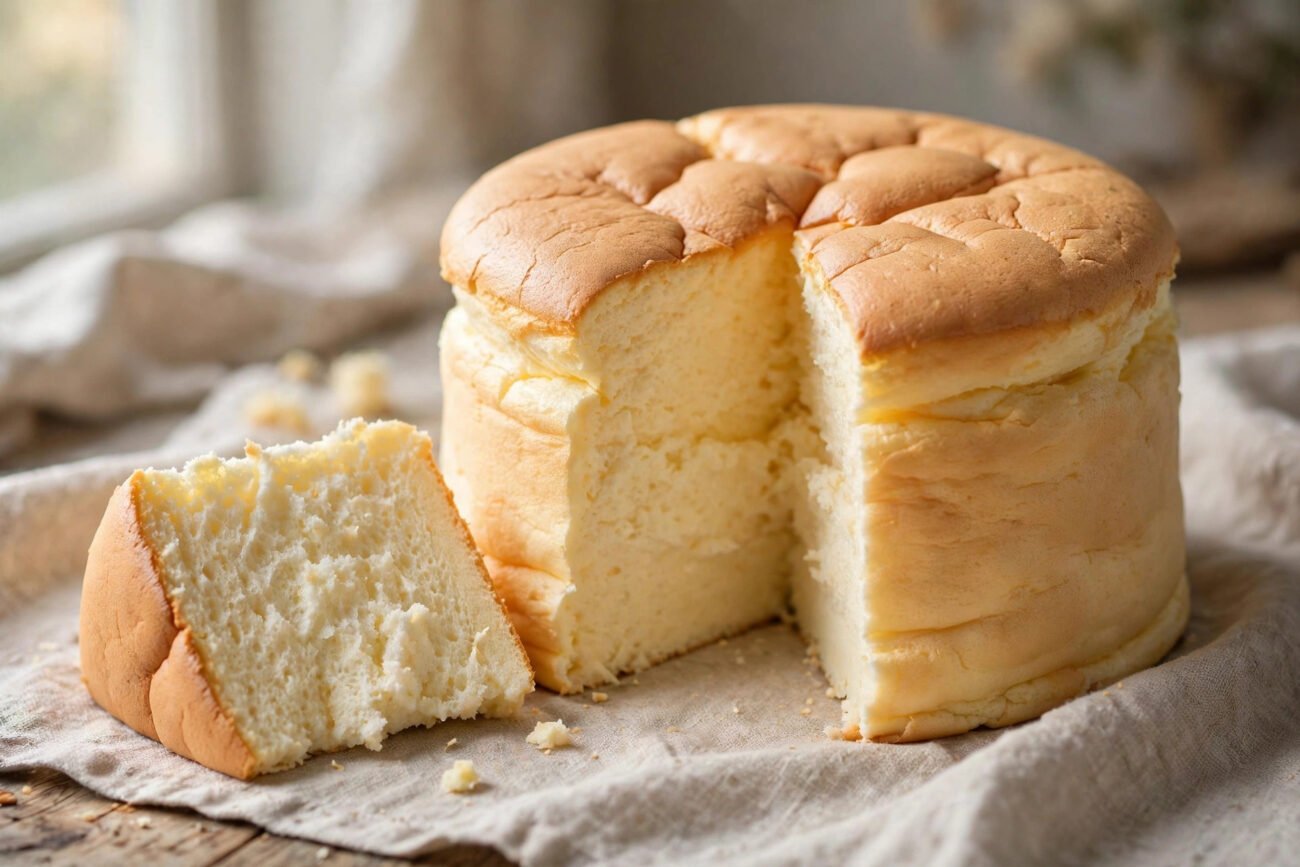
Okay so. Cloud cake. The name isn’t overselling it — this thing is stupidly soft, like it might actually float off the plate. It’s the Japanese cotton cake, half sponge, half soufflé, and it does this little jiggle when you nudge the plate. Then it just dissolves on your tongue. Gone.
My first one? A mess. Top cracked like a dry riverbed, middle sank as it cooled. Two fixes sorted it — a water bath (yes, the tin sits in hot water while it bakes, sounds odd, works) and a lower oven than I wanted. I wanted fast and hot. The cake wanted slow. The cake won.

Why You’ll Love This Recipe
Look at the ingredient list — nothing weird. Eggs, milk, a bit of oil, flour, sugar. Stuff you’ve probably already got. The whole trick is the method, and the method isn’t even hard. It’s just… specific. Steps in order, don’t freelance the temperatures, you’re fine.
And it’s different from your usual cake. Most cakes are rich and heavy and sit in your stomach like a brick. This one isn’t. Kids lose their minds over the jiggle, by the way — like it’s a magic trick.
Ingredients
Makes one 7-inch (18 cm) round cake. A springform or loose-bottom tin is easiest — you’ll thank yourself at unmoulding time.
- 5 large eggs, separated (whites in a big clean bowl, yolks in another)
- 1/4 cup neutral oil (60 ml) — sunflower or light vegetable oil
- 1/3 cup milk (80 ml), at room temperature
- 1 teaspoon vanilla extract
- 3/4 cup cake flour (90 g), sifted — plain flour works too
- 1/4 teaspoon salt — sounds like nothing, I know, but leave it out and the whole cake tastes oddly flat, so in it goes
- 1 teaspoon lemon juice or 1/4 teaspoon cream of tartar (helps the whites whip and hold — either one does the job, I just grab whichever is already in the cupboard)
- 1/3 cup + 1 tablespoon sugar (75 g), for the whites — this lot is for the meringue, not the yolks, so keep it by the big bowl
- Boiling water, for the water bath — a kettle-full is plenty, you won’t use all of it
- Powdered sugar, for dusting over the top at the end (optional, but it makes it look finished, and it takes ten seconds)
Separate the eggs while they’re cold — yolks break way less that way — then let everything come to room temperature. And the bowl for the whites? Clean. Properly clean. Any grease in there and the whites won’t whip, and you’ll be whisking forever wondering why. Learned that one the hard way, believe me — I once stood at the counter whisking for a good ten minutes, arm aching, over a bowl that still had a greasy film in it from earlier, and the whites just sat there, flat and glossy, refusing to do a single thing.

Step-by-Step Instructions — Nothing Hard, Just Don’t Rush It
- Prep the tin and oven before you touch anything else, because once those whites are whipped there’s no pausing to line tins — parchment in the base and up the sides, the side paper standing about 2 inches above the rim, because this cake rises and it needs the wall to climb. Springform or loose-bottom tin? Then take the extra minute to wrap the outside in two layers of foil and press it on snug, right up the sides — I got lazy about this once, one loose sheet thrown round it, and the bath water crept straight in and soaked the base of the cake. Two. Bath water finds any gap. Oven at 300°F (150°C), and put the kettle on.
- Make the yolk base. Oil and milk, whisk them together. Yolks and vanilla in, whisk till smooth. Sift the flour and salt over the top and whisk gently — gently — just until no dry flour shows. Don’t beat it like it owes you money. Smooth, not elastic.
- Whip the egg whites. Big clean bowl. Whisk till foamy, add the lemon juice or cream of tartar, then the sugar in 3 additions, whisking as you go. Soft-to-medium peaks is the target — the peak stands, but the tip curls over soft. Stiff and dry? They fold in badly and can crack the cake. Stop before that.
- Fold, don’t stir. Whisk about a third of the whites into the yolk batter first, to loosen it. Then the rest in two goes with a spatula: cut down the middle, scoop under, turn the bowl, repeat. Pale, fluffy, mousse-like — that’s where you stop.
- Into the tin it goes — pour the batter in from a slight height, which sounds like a chef-y flourish but genuinely helps it settle, then tap the tin twice on the counter, swirl a skewer through it to release the air pockets hiding in there, and smooth the top over quickly with the spatula without sitting there perfecting it.
- Now the water bath, which is the big secret of this whole recipe, by the way — tin into a larger roasting pan, then freshly boiled water poured in around it to about 1 inch (2.5 cm) up the side, and yes, it feels like you’re drowning your cake, you’re not, the water never gets inside, it just keeps the heat gentle and damp in there. Hot water, that’s all it is.
- This is the low-and-slow part and there’s no hurrying it — set the oven to 300°F (150°C) and give the cake a full 55 to 65 minutes in there, which I know sounds like forever for a cake this small, but that gentle heat is the whole trick here, and rush it and you’ll pay for it. Whatever you do, keep that oven door shut for the first 40 minutes — do NOT keep cracking it open for a quick peek, because that’s exactly what I did with my first two, standing there every ten minutes just to check on it, and both of them cracked, and I can’t honestly pretend the two things aren’t connected. Every time that door opens the heat rushes out and the temperature drops with it, and a cake this delicate doesn’t forgive that sort of thing — it sinks, plain and simple, I’ve watched it drop right in front of me. You’ll know it’s done when you press the top very lightly with a fingertip and it springs straight back instead of holding the dent, and when a skewer poked into the middle comes out clean, with no wet batter clinging to it — the odd crumb or two is fine.
- Cool it gently. Oven off, door a crack, cake stays inside for 10 minutes — sudden cold air makes these cakes shrink and wrinkle. Then, once it’s out of the bath, comes the bit that feels completely wrong the first time you do it — pick the tin up and drop it back onto the counter, just the once, gently, from about 6 inches up, purely to knock the trapped steam out before it settles in and turns the crumb damp, unmould, peel off the paper, cool on a rack.

Tips / Common Mistakes
- If your top comes out cracked, don’t overthink it — nine times out of ten it simply means the oven was too hot for it, and that was the story behind nearly every cracked one I ever pulled out. And if you already know your oven runs hot — most of them do, mine sits a good few degrees over what the dial claims — then drop it to 285°F (140°C) from the start instead of waiting for a crack to tell you.
- If the middle sinks on you as the cake cools, work backwards through the usual culprits — it was underbaked, or somebody opened the oven too early, or the whites got whipped past soft and into stiff, dry territory. One of those three.
- Don’t skip the water bath. Baked dry, this is just a regular sponge with a tough base. Fine cake, wrong cake.
Variations & Substitutions
Matcha: this one’s easy — just sift 1 tablespoon of matcha in with the flour, and take the same amount of flour back out again so the balance stays right, because if you pile the matcha on top without taking any flour away, the batter ends up that bit too dry. It comes out the loveliest pale green, the flavour stays gentle rather than grassy or bitter, and honestly it looks far prettier than the extra thirty seconds of effort deserves.
Cheese version (Japanese cotton cheesecake): if you’re taking it in that direction, warm 100 g of cream cheese together with the milk, stirring until it’s completely smooth and lump-free, before the oil and yolks go anywhere near it — try tipping cold cream cheese straight in and you’ll be left chasing little white lumps through the batter. It ends up tangier and noticeably richer than the plain cake, but — and this is the important bit — it still does the jiggle when you nudge the plate.
Serving Suggestions
My favourite way is also the simplest — dust the top with powdered sugar and serve it exactly as it is, ideally still faintly warm if you can time it that way, which I manage roughly half the time, and nobody has ever complained about the other half. For clean edges, run your knife under the hot tap and dry it off before each cut instead of dragging a cold blade through and tearing the crumb — and don’t be surprised when the slice trembles the whole way from the cake to the plate, because that wobble is half the fun of serving it. That’s the whole point.

Storage & Reheating
Airtight container, in the fridge, up to 3 days. It firms up slightly when chilled — and some people (me) actually prefer it cold from the fridge. To refresh a chilled slice, 10 seconds in the microwave brings back most of the softness. Don’t overdo it or it goes rubbery. Freezing? Not recommended — the delicate structure turns spongy and wet when it thaws.
FAQs
Why did my cloud cake crack on top?
Oven too hot, usually — that’s the one I’d put money on. Or the whites went too far, all the way to stiff, dry peaks. So drop the heat down a touch lower than you think you need, honestly lower than feels right, and when you’re whipping the whites, have the nerve to stop while the peaks are still soft and curling over at the tips, because everything in you will want to push on until they stand up stiff and proud, and stiff and proud is exactly what cracks the top.
Why did my cake sink after baking — it looked fine in the oven?
More often than not, if I’m honest with myself, it was simply underbaked — the top looked set and golden and completely convincing, but the middle hadn’t quite got there, and a middle like that has nothing holding it up once the heat’s off it, so down it goes, slowly, while it cools, and you stand there watching it happen. The other usual suspects are somebody cracking the oven door open too early for a look, or the cake being hauled out into cold air and cooling too fast — I’ve been guilty of both, the second one purely because I was too impatient to slice it. The fix is boring, there’s no clever trick to it, but it works — give it the full bake time even when it looks done early, because it is lying to you, keep the door shut for the first 40 minutes no matter how curious you get, and let it cool down gradually in the switched-off oven instead of rushing it out onto the counter like I used to.
Can I bake cloud cake without a water bath — do I really need it?
You can, nobody’s stopping you, but it won’t really be a cloud cake any more — the base gets firmer, the top cracks more easily, and the texture lands closer to a plain sponge, which is a perfectly fine cake, it just isn’t this cake.
What is the difference between cloud cake and regular sponge cake?
It really comes down to technique rather than ingredients, and I mean that quite literally — the eggs are separated, the whites are whipped into a meringue and folded through gently instead of just beaten in like a normal cake, and the whole thing bakes sitting in a water bath instead of in dry oven heat, and between them those three things, none of which cost a penny extra, are what lift it taller than an ordinary sponge, keep it softer, and give it that soufflé-like tenderness a regular sponge cake just doesn’t have, however good the sponge is.
Nutrition (Estimate — Rough Numbers, Nothing More)
Cut the cake into 8 slices and one slice works out at roughly 165 calories, 8 g fat, 19 g carbohydrates, 0.5 g fiber, 5 g protein and 13 g sugars — and do treat every one of those numbers as a rough estimate only, because that’s all they are, worked out for the plain oil version with no toppings on it, and the moment you add whipped cream or fruit on top the figures wander off on their own and stop meaning very much.
