

Confession before anything else, because we start honest or we don’t start at all, no point building a recipe on a fib — my first attempt at chia pudding was horrible. Kind is what horrible is, there. What actually happened: seeds, milk, stir, fridge overnight, exactly what the internet told me, the whole internet, every blog on it, all of them so confident, so completely sure of themselves. Morning comes and I’m looking at a grey cup of frogspawn that slid off the spoon in one piece. One. Whole. Piece. Two spoonfuls I managed — stubbornness, nothing else — and the rest went in the bin, quietly, late, when nobody was around to ask.
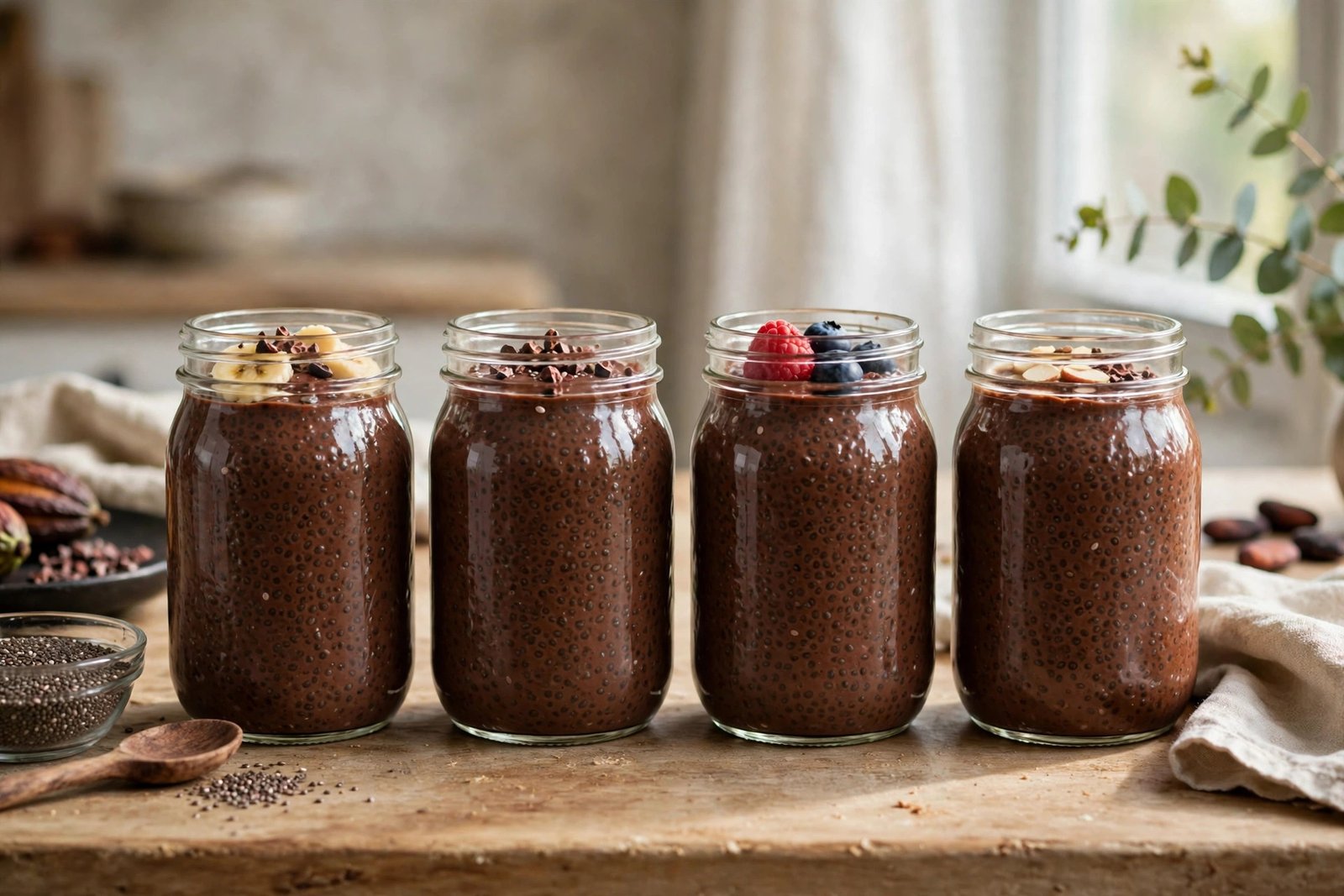
Wasn’t the pudding’s fault. It was mine, the method, and accepting that took me an embarrassingly long time, it really did. Three things I’d skipped. Cocoa — enough of it to actually taste of chocolate, a commitment, not a polite dusting. Salt, a pinch, unglamorous little pinch that changes everything and photographs like nothing. And a second whisk, ten minutes in, the step that stops it setting into clumps with thin milk sulking in the gaps between them. Done properly — done like that — it stopped being a health food I was enduring and turned into a dessert I make deliberately. Sundays usually. Jars. Lined up like little soldiers, so weekday me opens that fridge and feels past me has looked after her. Past me is thoughtful like that. Weekday me never writes back.
Why You’ll Love This Recipe
Cooking? There isn’t any. No hob. No oven. You don’t even boil a kettle at any point — five minutes of your hands, roughly, and then the fridge takes over while you’re asleep, which, as divisions of labour go, is exactly how I’d arrange the world if anyone asked me. And it’s a make-ahead breakfast that turns up after dinner passing as a proper pudding without changing a thing about itself. Depends what lands on top. That’s the whole trick of it.
Texture, when you get it right: thick. Coats the back of a spoon. Sits somewhere with mousse on one side of it and a set custard on the other, and this gentle pop off the seeds as you eat. And the chocolate — actual chocolate flavour, not that dusty rumour of chocolate you get in the sad versions. That’s the cocoa doing its job, with the salt and the vanilla backing it up. The salt, especially the salt. People leave it out, then tell me chia pudding’s bland, and I have to stand there being diplomatic about it, and diplomacy is not a thing I own before breakfast.
Ingredients
- Chia seeds, 1/2 cup of them — 85 g, if you’re weighing, and yes that little pile really does drink up all that milk, I didn’t believe it either the first time
- 2 cups (480 ml) milk of your choice — whole dairy milk, almond, or oat all work
- 1/4 cup (25 g) unsweetened cocoa powder — sift it if it is lumpy, and it will be lumpy, it is always lumpy, I have never once opened a tub of cocoa that was not lumpy, I think it does it in the dark, for fun
- 3 to 4 tablespoons maple syrup or honey, to taste — start low, because the fridge steals sweetness, we will get to the fridge’s crimes later
- 1 teaspoon vanilla extract — the real stuff if you have it, the other stuff if you don’t, no judgement either way, it is going into chocolate
- A good pinch of fine salt — do not skip this, do not even think about skipping this, I will know, the pudding will know, the pudding tells me everything
- Optional: 1/2 teaspoon espresso powder, purely to deepen the chocolate — you will not taste coffee, I promise, I have run the experiment on people who hate coffee and they tasted chocolate and smugness, that is all
And to serve — this is where it stops being breakfast prep and the dessert theatre kicks in, honestly — any of these: raspberries, fresh ones, or strawberries sliced up, a dollop of whipped cream, Greek yogurt if that’s your direction, dark chocolate shaved over it, roasted hazelnuts chopped up rough, whatever’s in the house that makes you feel like somebody whose life is together.
Step-by-Step Instructions — Five Minutes of Work, Honestly
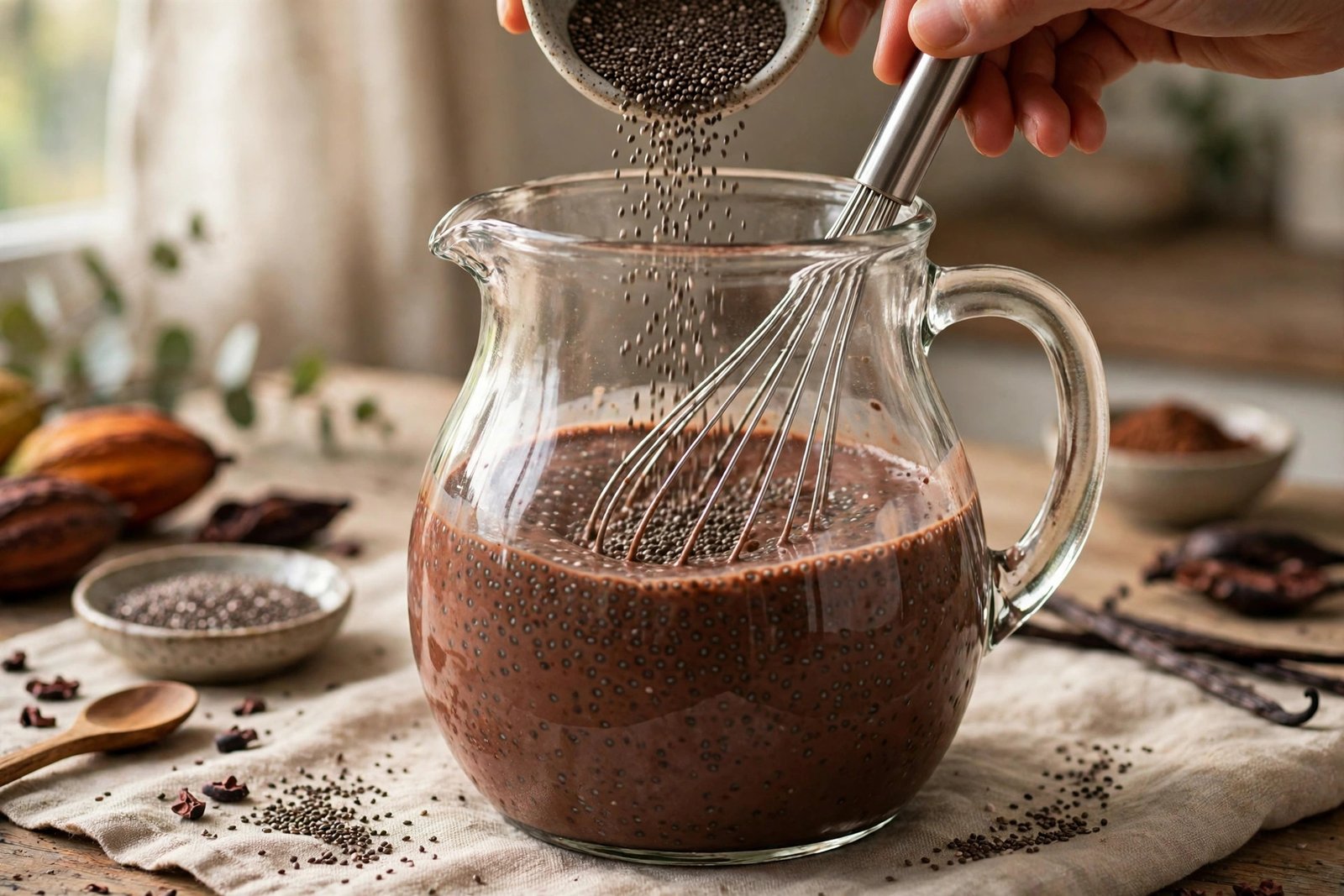
- The dry things go in first. Cocoa, salt, the espresso powder too if it’s making an appearance — into a bowl, medium, or a big jug, and jug is the word I’d underline there, because getting this into jars later off a jug is civilised and off a bowl it is a laundry incident, I own the t-shirt, the t-shirt has spots. Cocoa lumpy? It will be, see above, it always is — sieve it, small sieve, shove it through now. Do not stand there thinking the whisk sorts it later. The whisk does not sort it later. Lumps of cocoa don’t dissolve, they go into hiding, patient little things, and they surface between your teeth halfway through a spoonful at breakfast like tiny bitter landmines laid just for you.
- In go the milk, the maple syrup and the vanilla, and you whisk — properly whisk, not a token swirl — until the cocoa has fully mixed in and the whole thing looks like chocolate milk, because that, legally and technically, is what it now is: congratulations, you have made chocolate milk, the recipe is nearly beneath you at this point, press on anyway.
- Add the chia seeds and whisk again, thoroughly, for a good 30 seconds, scraping around the bottom and the sides where the seeds like to gather in a clump and plot. They start plotting immediately. Thirty seconds of whisking is the counter-plot.
- Now walk away for exactly 10 minutes. Set a timer. Yes, exactly — not “a bit”, not “while I check my phone and lose track of my whole afternoon” — ten minutes, timer on. This pause lets the seeds start swelling before their final set, and it is doing quiet, essential work while you do nothing, which again: ideal arrangement.
- Whisk the whole thing again. Properly. Break up any clumps you find, lift the seeds that have sunk to the bottom like they’re hiding from the spoon — they are — and get everything even. This second whisk is the entire secret. It is the difference between a smooth pudding and a layered accident. If you take one sentence away from this whole recipe, take that one.
- Cover it, or pour it into 4 jars or glasses and cover those, and into the fridge for at least 4 hours. Overnight is better — the texture settles, the cocoa flavour deepens, everything relaxes into itself. Four hours is the minimum and overnight is the recommendation, and I have, in an emergency, eaten it at three hours, standing at the open fridge. It was fine. The fridge light forgives.
- Before it goes anywhere near a table — before, mind, not with people already sat there holding spoons like a little jury — stir it and have a proper look at the consistency, investigative stir, spoon up, let it fall. Too thick? Splash of milk, stir it loose, sorted. Too thin? Another teaspoon of chia seeds goes in and it gets 30 more minutes in the fridge, no drama. Both problems fix themselves that way, both, which is more courtesy than most desserts extend a person — nobody ever fixed a collapsed soufflé with a splash of milk and half an hour.
- Then it goes into bowls — or it doesn’t, and it gets served straight out of the jars, which is my way, like a woman with nothing to prove, because there isn’t anything to prove, the pudding’s in a jar and the jar is enough. Toppings happen at the table. Everyone does their own, nobody’s got grounds to complain, and that isn’t laziness, that’s governance. Democracy, in pudding form.
Tips and Common Mistakes — Or, How I Stopped Ruining Pudding
- The clump thing. I’m saying it again because it bears saying twice, and somebody reading this will still skip it, I know it in my bones: nearly every bad chia pudding ever made — grey, lumpy, spoon standing upright in it like a flag — traces back to the same crime. Whisked once. Once. Then left to get on with it, like a houseplant you’re hoping survives your holiday. They gel quick, these seeds, they stick to each other while they do it, and the gel sets round a dry little centre, and after that? Stir all you like. You can improve it. Resurrect it you cannot. Ten minutes. Second whisk. That’s the recipe, the actual recipe. Everything else here is commentary.
- Sweetness — judge it cold, after the chilling, not before, if waiting is in you at all. Cold flattens sweet, that’s just what cold does, so a mix that tastes spot-on warm on the counter can come out of that fridge tasting flat and a bit sorry. My way round it: less syrup at the start, the smaller amount, then taste it set and cold and stir more in at serving if it’s asking. It usually asks. The fridge steals sweetness, it’s a known thief, plan around it.
- Use fresh-ish chia seeds. Seeds that have sat at the back of a cupboard for two years — and we all have that bag, don’t pretend — still gel, but more weakly, and the pudding can end up thin no matter how long you wait. If yours has been open since forever, use an extra tablespoon of seeds to compensate. Cheap insurance.
- Grainy texture usually means the cocoa went in unsifted and dry. If it has already happened, do not bin it: a quick blitz with a stick blender smooths the whole batch out — and actually, that blended version is a legitimately different, silkier pudding that some people prefer on purpose. My sister prefers it. She is wrong, but she is allowed.
Variations and Substitutions — Same Pudding, Different Agenda
Mocha: this is where the espresso powder stops being optional and gets a promotion — use it, and swap half the milk for cooled strong coffee, and what you get is breakfast with a pulse, breakfast with a diary and a commute, breakfast that has somewhere to be and is already slightly late.
Peanut butter cup: swirl a tablespoon of runny peanut butter through each jar before chilling — ribbons of it, do not stir it in properly, ribbons — and top with chopped peanuts, and then just watch, because this is the version that disappears first in my fridge, every single time, without exception, and I live with a person who claims, claims, not to like peanut butter, and yet the jars empty themselves, apparently, by magic, overnight. Claims.
Chocolate orange: in goes the finely grated zest of half an orange — just the orange part, the zest, all that perfume — and the espresso stays out this time, benched, because orange and coffee would only argue. It tastes like those chocolate oranges you whack with a mallet at Christmas — the segmented ones, you know the ones — and it makes the whole kitchen smell incredible for a while afterwards.
Blended mousse style: after chilling, blend the set pudding until completely smooth. It loses the seed texture entirely and eats like a dark chocolate mousse. Nobody will guess what it is made of. I have run this experiment on guests. Nobody guessed. One person guessed “some kind of truffle situation”, which I am counting as a compliment.
For a richer dessert version, replace half the milk with coconut milk from a can — the thick canned kind, not the carton drink — and serve with whipped cream. For a lighter one, almond milk and berries does the job nicely, and you can feel virtuous, if feeling virtuous is a thing you enjoy alongside pudding.
Serving Suggestions
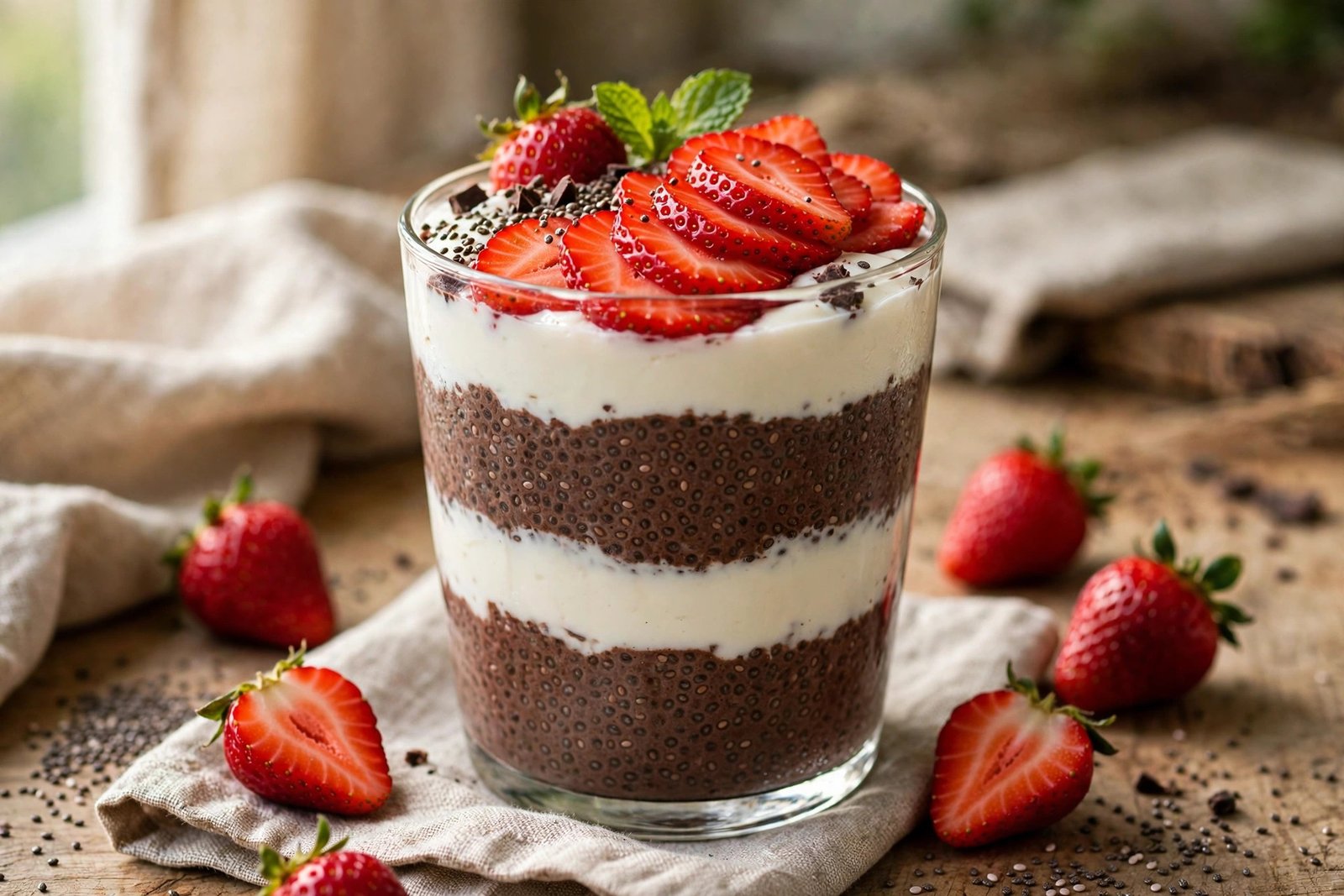
For breakfast, the jar version with yogurt and berries layered in feels like something from a café fridge — the kind with the handwritten labels and the alarming prices — and costs a fraction of it. Grab, spoon, go. Out the door. Living well.
For dessert, serve it in small glasses — it is rich, richer than it looks, small glasses are your friend here — with whipped cream, shaved chocolate and one perfect raspberry doing decoration duty on top. And a tiny pinch of flaky salt on each glass, which startles people in the best way. Startled is good. Startled means they are paying attention to the pudding.
Storage and Reheating
This pudding lives in the fridge, covered, for 4 to 5 days quite happily — which is the entire point of it, let’s be honest, the whole jar system collapses without that shelf life. The flavour actually improves on day two. Give it a stir before eating, since it can separate slightly as it sits; one stir fixes it, no drama.
There is no reheating. It is a cold pudding, and warm chia pudding is not a road anyone needs to go down — I say this with love and without explaining how I know, although you can probably guess how I know. If it has frozen by accident at the back of an overenthusiastic fridge, let it thaw and stir well; the texture will be a bit looser, but edible. Accidental freezing is a fridge’s way of keeping you humble.
You can deliberately freeze it, in portions, for up to a month. Thaw it overnight in the fridge — slowly, properly, no microwave heroics — and know that the set will be slightly softer than fresh, a bit looser in its morals, which is exactly why frozen batches are best used for the blended mousse version, where you are going to blitz it smooth anyway and nobody, nobody, can tell it ever saw a freezer, because planned freezing is strategy, accidental freezing is just weather, and I support exactly one of those.
FAQs — Asked While Holding a Spoon
Why is my chia pudding runny — it had all night, what was it doing?
One of three culprits, always: either the ratio was off, or the seeds are old — see the cupboard confession above, we do not need to relitigate it — or, and this is the one nobody wants to hear, it simply has not had its full time, because chia needs a minimum of 4 hours and prefers overnight, properly prefers it, and it does not care that you are in a hurry, your hurry is not an ingredient — and if it is still thin after a full night, stir in a teaspoon more seeds per jar and wait another half hour, and it will get there, it almost always gets there, in its own time, like a cat deciding to come home.
Can I use water instead of milk — asking for my grocery budget?
Technically yes, and it will set — chia is obliging like that, chia would set in almost anything — but it tastes thin and a bit sad, more chocolate jelly than pudding, and life is short and pudding is pudding, so if dairy is the actual issue, any plant milk works fine, coconut and oat give the creamiest results by a distance, because creamy is the goal here, creamy was always the goal, jelly is not the goal, jelly was never invited.
Can I make it without any sweetener — is that allowed, structurally?
Yes — structurally it works completely fine, the set doesn’t care about sugar at all, the set would happen in a puddle — but flavour-wise, brace yourself, it will be bitter, properly bitter, because unsweetened cocoa is bitter, that is its whole personality, it is not hiding it — although if you are avoiding syrups and honey, a mashed ripe banana whisked into the base sweetens it gently, quietly, without a fuss, and yes it changes the flavour a bit, banana being banana and constitutionally unable to keep a low profile, but gently, pleasantly, in a way most people end up liking.
How much does this make — be honest, is it enough?
As written, four modest servings — about half a cup each, which sounds small until you remember this is a rich pudding, dense, committed, and trust me on this because I have tested it extensively: your eyes will want more than your stomach does, your eyes are writing cheques here. Double it freely; the ratios scale exactly, and it keeps for days anyway, so a double batch is just good management.
Is it breakfast or dessert?
Both, and this is its great trick. With berries and yogurt piled on, it is a filling breakfast with real, actual staying power — you will not be rummaging for a biscuit at eleven, you will not even think about the biscuit, and I am speaking here from extensive personal research, a whole programme of it — whereas with cream and shaved chocolate it becomes, seamlessly, a dinner-party pudding, respectable, presentable, the same jar wearing a different hat entirely.
Nutrition — The Numbers, Such As They Are
Numbers, then, with estimate only in big letters over the whole lot. This is per serving. It makes 4 servings — that version, the one with whole milk in it and 3 tablespoons of maple syrup. Roughly 235 calories you’re looking at. Fat 11 g. Carbohydrates 28 g, fibre 9 g of that, protein 7 g, sugars about 15 g. Swap in almond milk and those numbers slide down. Coconut milk and they climb, coconut milk climbs everything, it delights in it, we’ve discussed this. The chia itself is quietly bringing fibre and omega-3s along regardless, no speech, no fuss. And it’s a home-kitchen estimate, the whole paragraph — a guide, a sketch, not a lab report. No white coat has been anywhere near my kitchen. The pudding likes it that way and so do I.
