
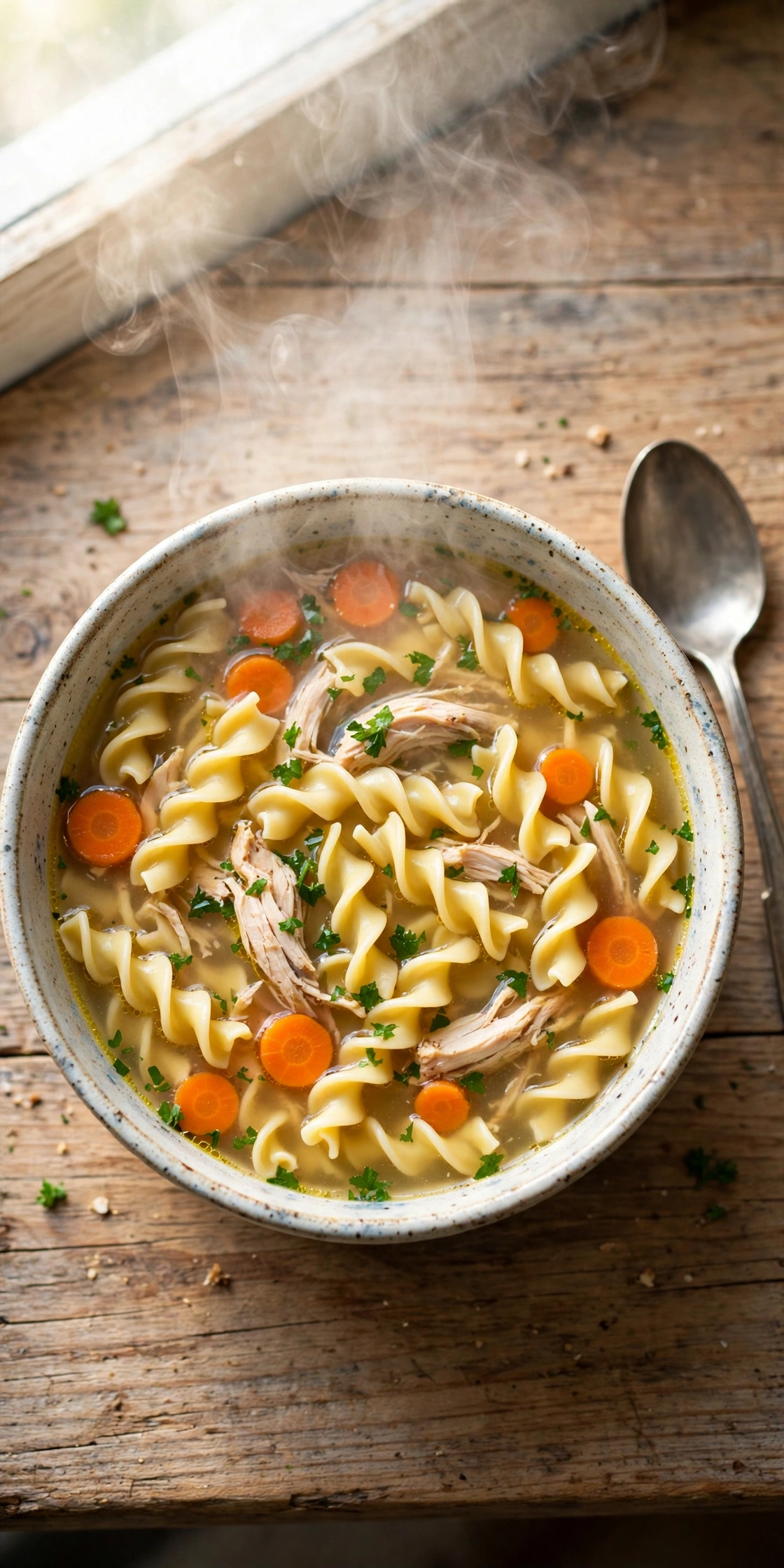
Rain again. Not proper rain. That thin sideways November stuff that sneaks under your collar and into the one weak bit of your shoe, and four o’clock and already dark, which still feels rude.
My friend got in at half six. Shoulders soaked clean through. Nose going. Voice down near his boots.
“Kuch hai?” he croaked.
There wasn’t. There would be.
He never actually asks for this soup. He doesn’t have to. Some evenings make the decision for you, and this was one of them — weather, buses, sinuses, the whole defeated bundle.
I have made it more times than I can count.
For the kids when they were small and hot and miserable and didn’t want food. What they wanted was to be held — soup and arms, in whichever order worked.
For Mrs. Okafor over the road after her operation, me carrying the pot across, lid rattling the whole way.
And sometimes for nobody.
Dressing gown. Wet hair. Standards under the sofa.
That is the real test — feeding yourself decently when you feel rotten. This passes.
Nothing posh goes in it. Lemon right near the end, and before you pull that face — the lemon is not a garnish. It is the hinge the whole bowl swings on
Fifty minutes start to finish, most of it the pot burbling away by itself. Here is exactly how, blunder and all.
Why This Soup Works
Gentleness. That is most of it, and nobody puts it in a headline because it sounds too plain.
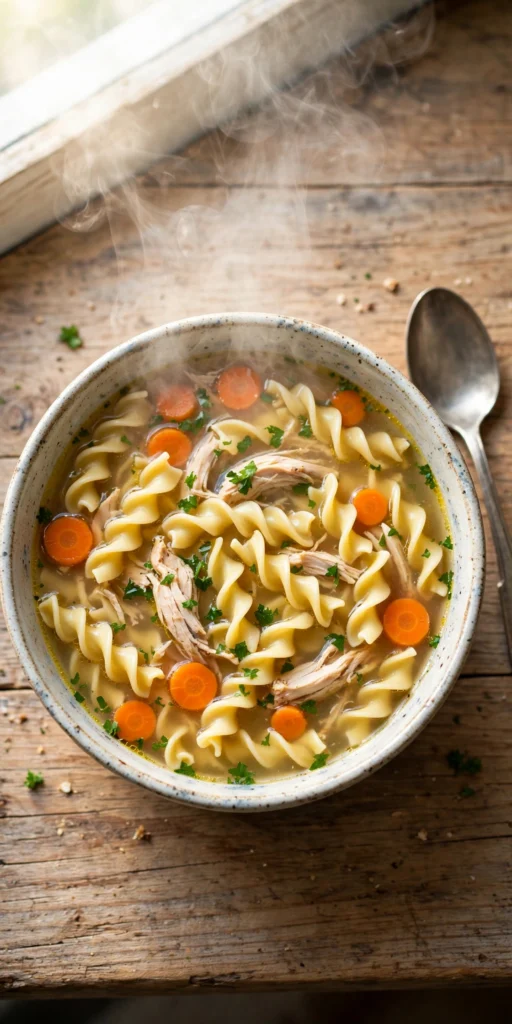
No boiling the chicken into rags in this house — I’ve done that, years ago, and ended up fishing sad grey strings out of the pot like I was unpicking a jumper nobody wanted. What I do is poach it — broth barely troubling the surface, a bubble surfacing now and then when it remembers — so the meat stays soft instead of stringy and the soup stays that clear colour you can see your spoon through. Gold, nearly.
The noodles go in last. Last. Always last.
I have strong feelings about this and the section further down explains why.
And after that it’s the lemon’s turn — the lemon does the rest, the showing-off part, which is slightly unfair on the chicken but there it is. One squeeze, right at the end, through my fingers to catch the pips, and the whole bowl sort of sits up straighter, like it’s just heard its name called. Skip the lemon, though, and the whole thing sits in the bowl flat and beige and worthy — the soup equivalent of being lectured about fibre by somebody at a bus stop. Put it in — half a lemon, no more heroics than that — and suddenly everything in the bowl is awake and paying attention.
Timings, because a sick person’s patience is a short and precious resource in this house: 15 minutes of prep, 35 of cooking, 50 all told before somebody’s standing in the kitchen doorway asking where it is. That pot feeds 4 properly hungry people, or 6 as a starter — and on the night in question it fed one husband twice and me standing up by the hob, which I suppose is its own category.
What Goes In — a Shopping List Said Out Loud
Chicken first. I have a speech about the chicken.
- 500 g (1 lb 2 oz) boneless, skinless chicken thighs — thighs, I will die on this hill, breast turns to string the second your back is turned
- 1 tablespoon (15 ml) olive oil — the ordinary bottle by the hob, nothing with a pedigree
- 15 g (1 tablespoon) butter — yes, both, the oil minds the butter and the butter makes the kitchen smell like a competent adult lives here
- 1 large onion, finely diced, about 180 g (1½ cups) — cried over it, standard, you will too
- 3 medium carrots, about 250 g (2 cups), cut in chunky coins — coins, not shavings, shavings vanish
- 3 celery stalks, about 150 g (1½ cups), sliced — leafy tops too if they still look lively, you know the look
- 3 cloves of garlic, minced — three, not one polite clove waved vaguely at the pot
- 1.5 litres (about 6½ cups) chicken stock — homemade if you have it, and I will lower my voice here, a cube is completely fine, I have crumbled one from the back of the cupboard and the soup never told on me
- 2 bay leaves — these will hide and surface triumphantly in somebody else’s bowl
- 1 teaspoon dried thyme, or 4 fresh sprigs — whichever your kitchen has, no judgement
- 150 g (5 oz) dried egg noodles — held back under guard until nearly the end, however tempting it is to chuck everything in together — a trap
- Juice of ½ a lemon, plus more at the table — see above re: hinges, also catch the pips, a pip in a sick person’s soup is a betrayal
- A handful of parsley, chopped rough — nobody is grading the chopping
- Salt and plenty of black pepper — judged by mouth, not by bravery
That is the lot.
How It Actually Goes
- Biggest, heaviest pot you own, medium heat, oil in, butter in.
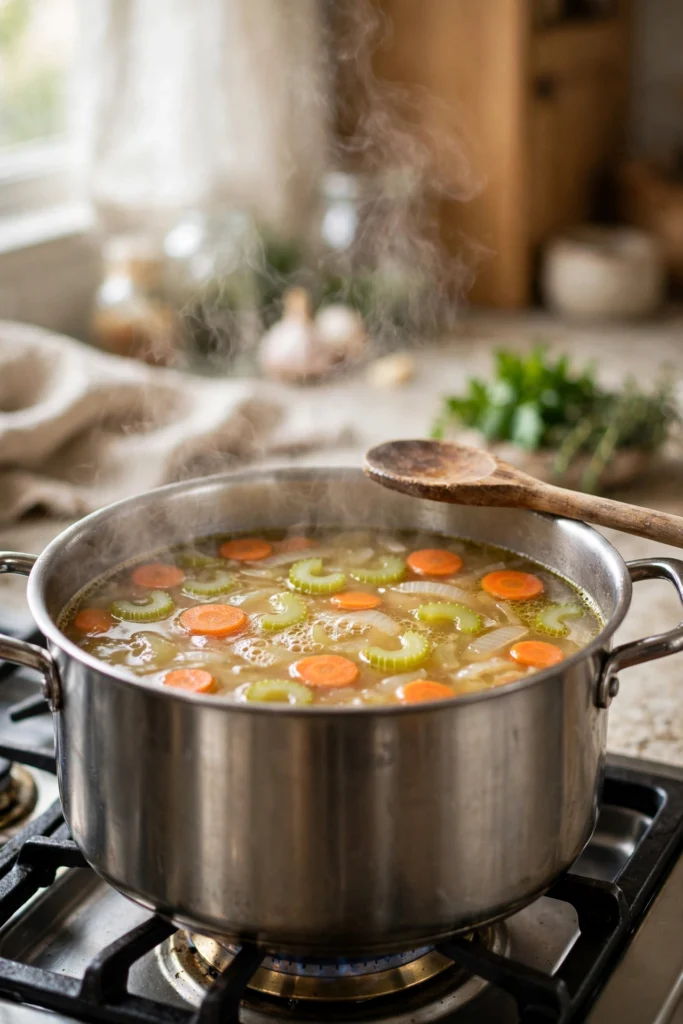
The second the butter has melted, in go the onion, carrots and celery with a pinch of salt for 7 to 8 minutes.
No colour. If it starts taking colour this early you’ve lost the plot a bit — browning belongs to roasts and Sunday things, not to a soup that’s supposed to come out gold and gentle.
You’re after the onion gone soft and see-through and slumped, the carrots looking brighter and giving a bit at the edges — and if the bottom of the pan starts catching and going brown and smug about it, the heat is too pleased with itself, so knock it down and don’t apologise.
Gentle soup. Gentle beginning.
- Garlic next, all of it, straight onto the vegetables.
Keep it moving — not a wander-off-and-check-your-phone moment.
30 seconds. Sixty seconds is the absolute ceiling, and even that only if your hob is a slow old thing like mine.
Raw it smells sharp, all needles and attitude; give it that short time in the warm oil and it goes round and sweet-tempered — and honestly your nose knows the moment before any clock does, so go by that.
Past it, the stuff burns bitter.
And there is no rescue, only starting again, and nobody with a sick person in the house is starting again.
- Every drop of the stock goes in.
In it glugs — that lovely stock-jug glug, the one that sounds like the pot sighing with relief. Waste nothing.
Then lower the chicken thighs in whole, bay leaves and thyme after them.
Now coax it up to the barest simmer you can get away with — a lazy bubble surfacing every few seconds, steam coming off in wisps, and absolutely not one of those rolling boils that bullies the whole pot.
Boil it hard and you pay twice over: the broth goes cloudy, like dishwater after a party, and the chicken — poor chicken — turns to that string you then have to chew through politely.
And we are not doing string.
- Lid half on, an escape hatch for the steam, and walk away for 20 minutes.
Actually walk away.
Then cut into the fattest part of the thickest thigh: white edge to centre, juices running clear, pink nowhere? Done.
Still pink? No drama whatsoever. Back it goes for 5 minutes.
- All the chicken out onto a board, two forks, and pull. It should fall into soft ribbons with barely any persuasion. Fighting the forks? It needed longer.
- And now.
Drumroll. Trumpet.
The noodles may approach.
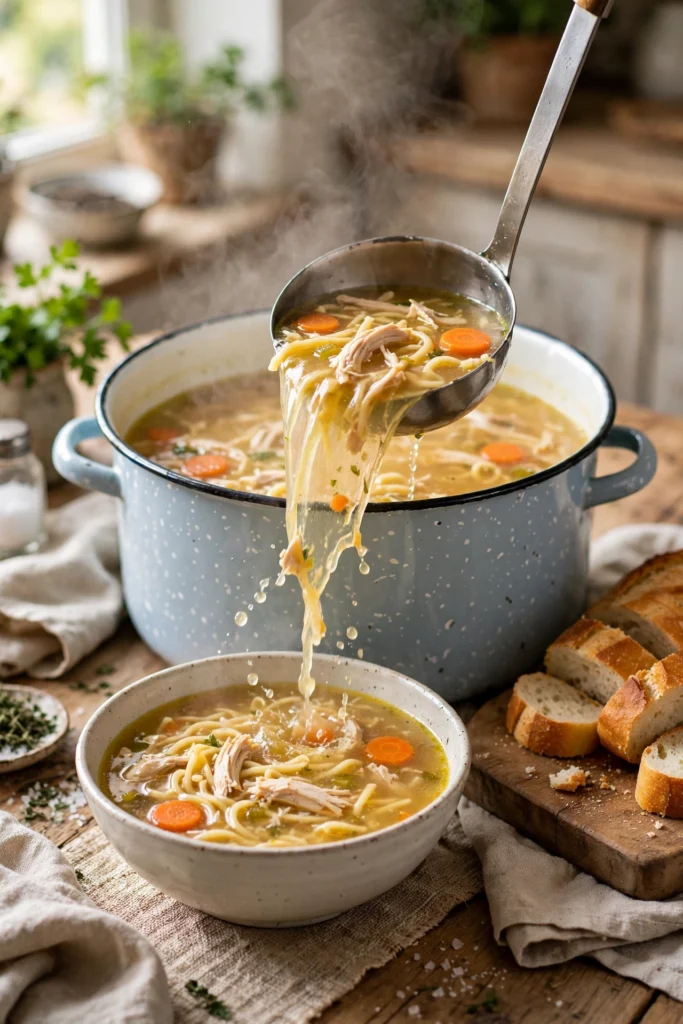
Into the simmering broth for 7 to 8 minutes, or a minute shy of whatever the packet says.
Fish one out. Blow on it. Bite it, and mind your tongue, it’s hotter than it looks: soft, yes, but with this tiny bit of fight still left in the middle.
Here’s the thing nobody warns you about: noodles don’t stop cooking just because you’ve stopped — they go on softening in that hot broth all the way across the kitchen, so if they taste perfect while you’re leaning over the pot, they’re past it by the time your husband’s got his spoon in.
Err early.
- Every ribbon of chicken back in for 2 minutes, just to heat through. Rescue the bay leaves if you can spot them. If one turns up in a bowl anyway, house rules are brutal: finder does the washing up. One genuine family argument so far.
- Heat off.
Completely off.
Lemon juice in, squeezed through your fingers so the pips land in your hand and not in the soup.
Parsley after it.
And then taste — a proper spoonful, not a distracted cook’s sip.
Salt and plenty of black pepper until the broth tastes very slightly too well seasoned on the spoon.
Which sounds wrong and isn’t.
Because the noodles drink salt as they sit, and by the table it lands exactly right.
The Mistake I Made for Years
Years. Plural. Say it with your chest: I used to put the noodles in at the start.
Chicken in, noodles in, everything simmering together like one big happy family, and the first night — lovely. Then morning came.
I always make a big pot — optimism is a lifelong condition — and I’d open the container and the soup had… set. One pale solid brick where dinner used to live.
Those noodles had been drinking all night. Broth? Gone.
Swollen into great soft eels, the whole lot practically sliceable, and we ate it anyway, with forks, and my brother asked, very politely, whether it was perhaps a casserole. My daughter, hearing this story years later, said — and I quote — “oh, so that’s what that was.”
The fix is offensive in its simplicity. Noodles in last, cooked in the broth right there at the end like they should be, and never, ever simmered along from the start like some ingredient that pays rent.
Planning to park what’s left in the fridge, or freeze it for some future grim evening? Do the noodles in their own pot of salted water, keep them in a separate container like they’re not on speaking terms with the soup, and drop a handful into each bowl as you serve it up.
Broth stays broth. Noodles stay noodles. Nobody eats soup with a fork.
Three Ways to Bend It
Make it creamy
Cold enough for the big jumper? Make it creamy.
Follow everything above, then — pot off the heat, non-negotiable — stir in 120 ml (½ cup) of double cream.
Give it one gentle minute to warm through.
Do not boil it.
Boiling splits cream, and split cream looks like your soup had an argument with itself.
Done right: paler, richer, softer.
Go spicy
For the cold where everything tastes of cardboard, go spicy.
In with the garlic goes 1 teaspoon of chilli flakes and a thumb of fresh ginger sliced into coins — coins so you can fish them out again if you are feeding cowards.
Finish with extra black pepper and the lemon, or lime instead.
By spoonful two my head starts to clear.
Slow cooker version
Slow cooker version, for days when you want the house to suggest competence while you personally do nothing.
Everything in except the noodles, lemon and parsley.
Low for 6 hours, or high for 3.
Chicken out. Shred it. Back in.
Noodles on high for 20 to 25 minutes until tender. Lemon and parsley at the end, because — say it with me — the lemon is load-bearing.
Leftovers: the Fridge, the Freezer, and Warming It Back Up
What’s left keeps in the fridge for up to 3 days — that’s the rule in this house, and by day three it’s usually been finished off by whoever gets home first anyway.
Fair warning, though, and I mean it kindly: those noodles carry on drinking broth all night like they pay rent on the fridge shelf, so by day two you’ve got something noticeably thicker on your hands — hovering, if we’re honest, closer to stew than soup.
Don’t stand there staring into the container like it’s ruined.
Just splash in some water — or stock, if there’s a bit lurking at the back of the fridge — while it warms back up. Half a mugful — the blue mug with the chip in the rim, if you’re me — is generally enough to rescue the whole pan.
Warm it through gently — low heat, a bit of patience — until it’s steaming right to the middle and not just putting on a show at the edges.
Give it a violent rolling reheat instead and the chicken toughens up out of spite, and the broth — the one you stood guard over to keep clear on purpose — clouds over in revenge.
Gentle. Again.
Freezer plans
Freezer plans are a present to future-you: freeze it without the noodles.
Broth. Chicken. Vegetables. Three months in there, easy, and nobody at my table has complained yet — Mrs. Okafor included, and she complains professionally.
When the day comes, thaw it back slowly in a pot on a low heat — no heroics — and once it’s properly hot, cook a fresh handful of noodles right there in the soup, which is how noodles like it anyway.
Tastes like you made it that afternoon.
Freeze the noodles in and, well. You know how that ends.
The brick.
A Last Word
Make it for somebody who came through the door wrung out by rain and sinuses. Make it for a neighbour. Make it for yourself without apology — especially for yourself.
Some recipes are just food. Others move in like furniture. Round here, this soup is furniture. Good furniture.
