
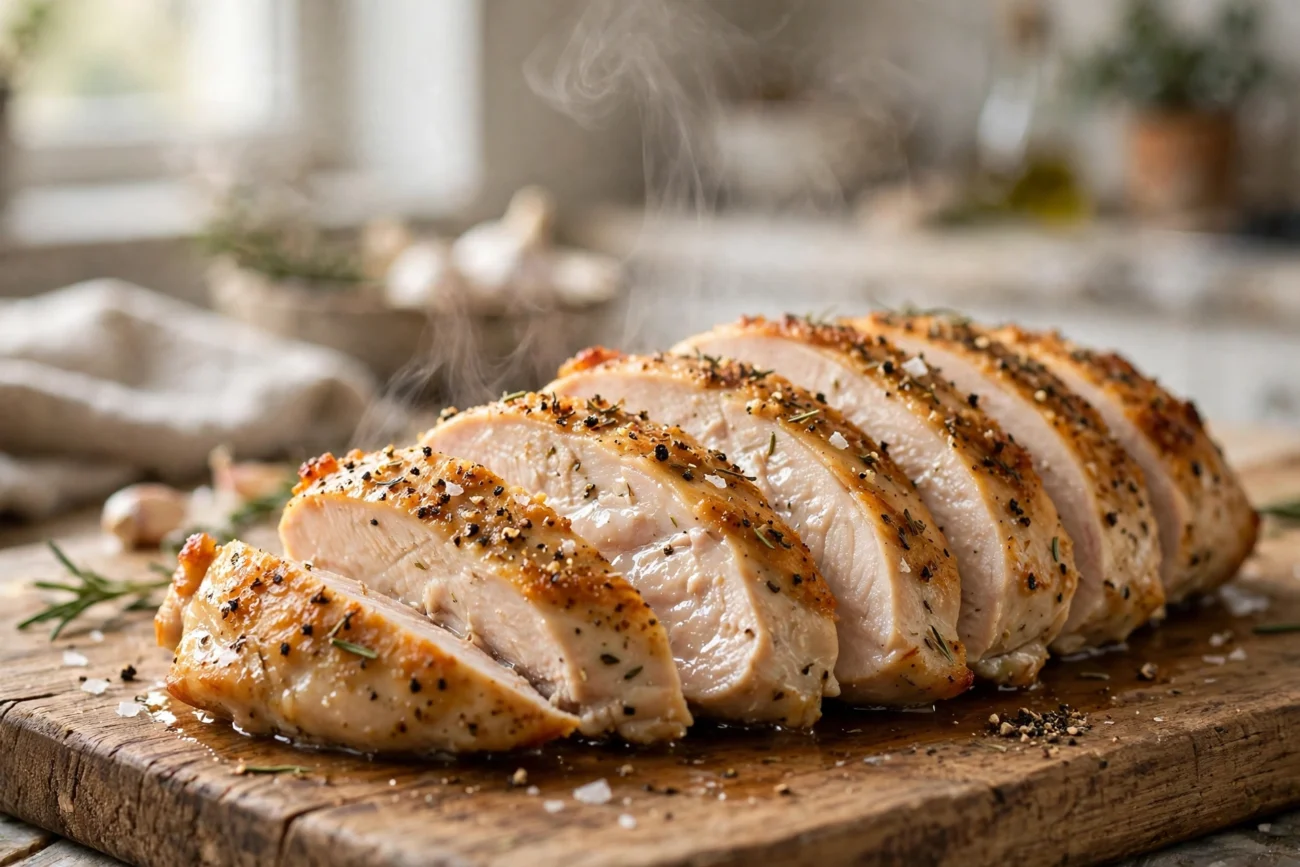
The knife squeaked.
Actually squeaked — that little rubber-on-glass noise — against the chicken, on a Tuesday, in my own kitchen, where I am supposed to know what I am doing.
My husband sawed away politely. He is a polite man. He sawed, and he chewed, and he sawed some more, and my daughter looked up and said: “It’s nice, Mum. It’s just loud to chew.”
Loud. Chicken. Those two words should never be introduced to each other.
For years I treated chicken breast as punishment food. Diet food. The beige apology you serve when you’re being good, in inverted commas.
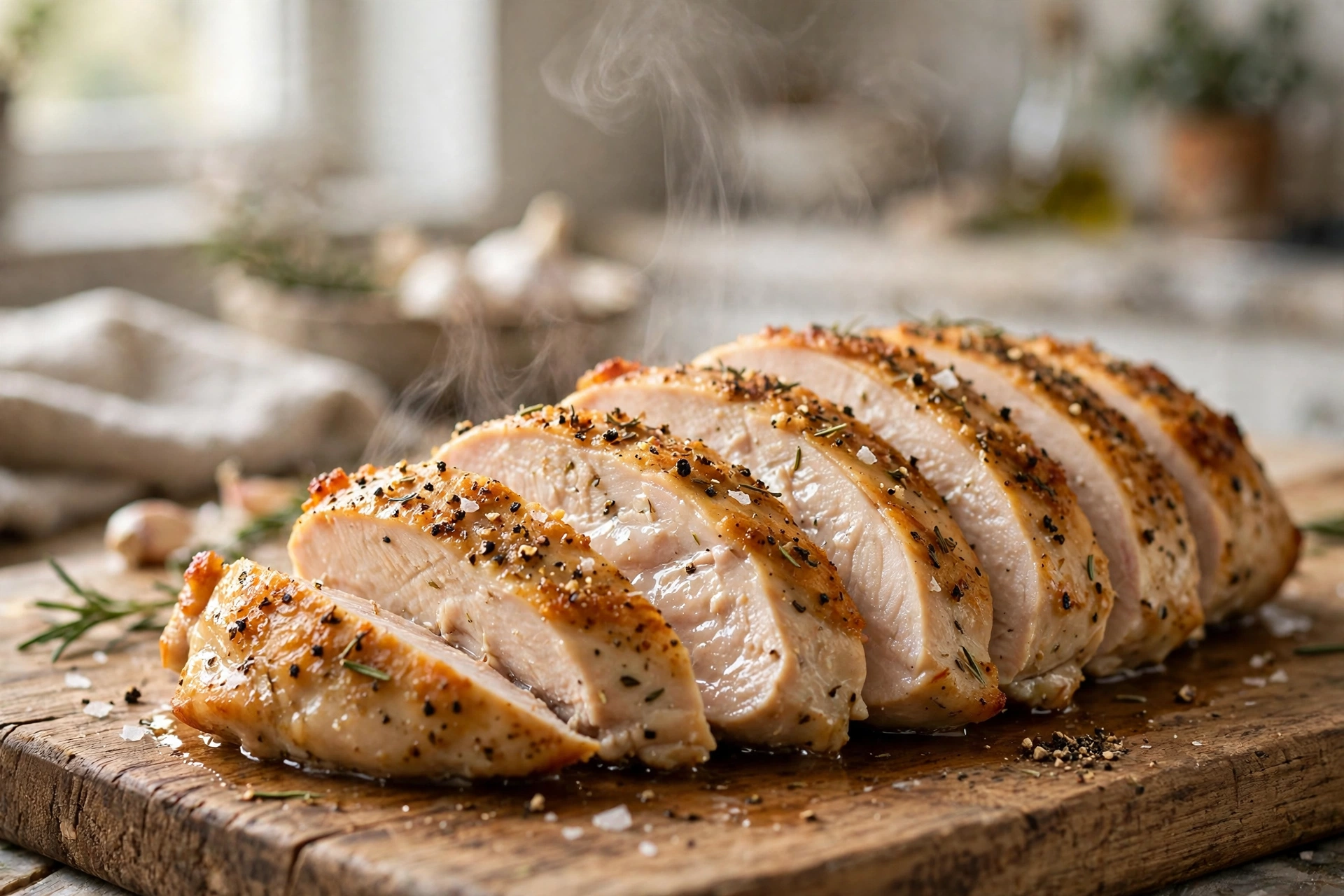
Then came a bowl of salty water and a thermometer that cost me £4.99 from the middle aisle of the supermarket, and the same bird started coming out juicy. Actually juicy. Slice it and it shines.
So this page is the fix, written down properly. The hero recipe first — the plain, juicy, baked one I now make twice a week without thinking — then three marinades for when plain starts to feel like a rumour. And all of it, every version on this page, runs on the same three acts of decency — my husband calls them that now, because I have said them at him so often: the salty-water brine (or a marinade, one road or the other, never both on the same bird), cooking to an actual number off the thermometer instead of to a feeling, and a rest afterwards that is meant, not waved at.
The Real Reason It Comes Out Dry
It is mostly not your fault. I want that on the record before we touch a recipe.
Chicken breast is lean — almost no fat running through it, nothing to forgive you with. A thigh has fat, and fat is a cushion, and cushions hide a multitude of sins. A breast has no cushion. It has a window.
And the window is narrow. One side of it: still faintly pink in the middle, send it back. A few degrees past the other side: cotton wool in a beige coat. In between lives about three degrees of glory, and most of us — me, for a decade — tried to find them by poking the chicken with a finger and hoping.
Stop poking. Start measuring.
The brine handles the other half of the problem. Salt water, half an hour, and the meat takes on extra water and holds it through cooking like a sponge that’s finally been told the plan. It’s not a project. It’s a washing-up bowl of salty water standing in the fridge while you unload the dishwasher.
Last thing: a chicken breast is shaped like a teardrop — fat at one end, tailing off to nothing at the other. The thin end cooks in half the time of the fat end, so by the time the middle is done the tip has the texture of a flip-flop. Level it. Bash the thick end down to an even 2 cm (¾ inch) and it all arrives at done together, like it was organised.
What Goes In — the Hero Recipe (Juicy Baked Chicken Breast)
Feeds 4, generously — or 2 tonight and 2 tomorrow, which is the arrangement in this house.
For the chicken:
- 4 boneless, skinless chicken breasts, about 800 g (1 lb 12 oz) in total — roughly 200 g each, the ordinary supermarket tray, nothing fancy
For the brine:
- 1 litre (4 cups) warm water — warm so the salt actually dissolves instead of sulking at the bottom
- 60 g (4 tablespoons) fine sea salt — fine, so it melts in properly; this is the whole engine of the recipe, don’t eyeball it
- 1 tablespoon sugar — it helps the chicken colour in the oven
For the rub:
- 1 tablespoon olive oil — the bottle by the hob
- 1 teaspoon garlic powder
- 1 teaspoon sweet paprika — the gentle one, the smoky one has its own section later and knows it
- ½ teaspoon onion powder
- ½ teaspoon black pepper
- ¼ teaspoon fine salt — a whisper only, the brine has done the heavy lifting and we are not salting the sea here
How It Actually Goes
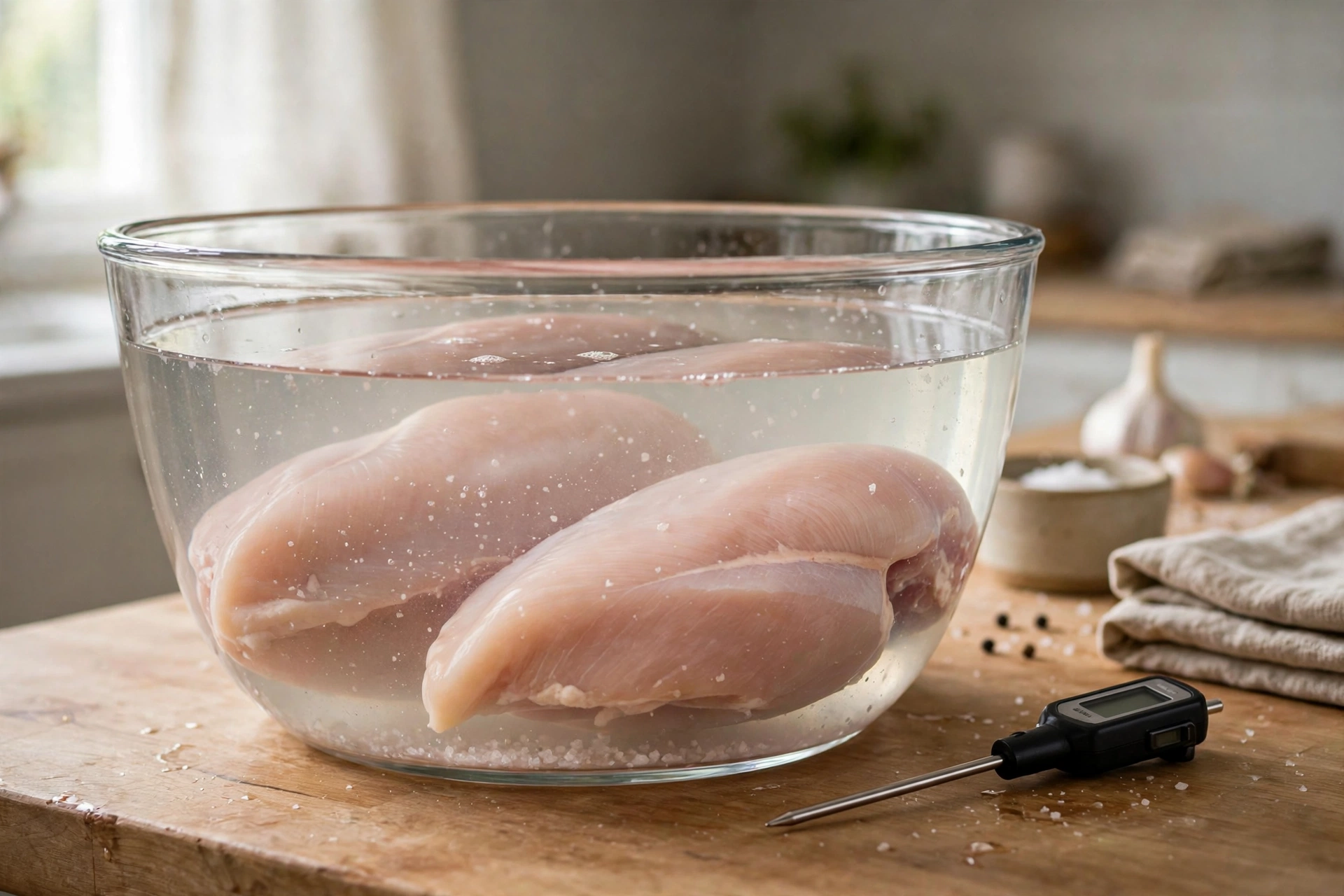
- Brine first. Warm water into the biggest bowl you own — mine’s the big glass one — salt and sugar in, stir until the water goes clear again. Chicken in. Fridge. 30 minutes.
Set a timer. An hour is the absolute ceiling, and past that the edges start curing like ham’s ambitious cousin, so don’t wander off and forget it. Ask me how I know.
- Oven on: 220°C (425°F), or 200°C if yours is a fan. Get a roasting tray ready — the heavy one, not the flimsy tray that warps and audibly complains.
- Chicken out of the brine, and now — pat it dry. Properly dry. Kitchen paper, both sides, no damp patches.
Damp chicken steams, and steamed chicken goes grey and sad and refuses to colour. Dry chicken, hot oven: that’s where the golden edges live.
- Level the breasts. One at a time into a freezer bag or between two sheets of cling film, and bash the thick end with a rolling pin — firm, flat whacks, not violence — until the whole breast is an even 2 cm (¾ inch) thick.
Therapeutic. The neighbours have learned to ignore it.
- Oil over every breast, then the rub, all over, both sides, with your hands. It will look like too little rub. It isn’t.
- Into the oven for 18 to 22 minutes — and here is where the £4.99 earns its keep. At 18 minutes, push the thermometer into the thickest part of the fattest breast.
You are looking for 74°C (165°F).
Not 80, because you got nervous. Not “a little longer, for luck.” At 74°C the chicken is cooked through, safe, and still holding every drop of that brine. That is the entire trick.
- Out. Onto a warm plate. Then foil over the top — loosely, tent-fashion, not tucked in tight like you’re putting the chicken to bed for the night.
Then leave it there, resting, for a full 10 minutes, phone timer on — the same 10 minutes I used to think were garnish.
Non-negotiable. Walk away. Put the kettle on. Lay the table.
In those 10 minutes the meat relaxes — straight out of the oven it’s clenched like a fist — and all the juice that rushed to the centre wanders back out to the edges where it belongs.
- Slice against the grain, thick slices, and tip every drop of the resting juices from the plate back over the top like you mean it. You made those juices. Twice, if you count the brine.
Three Marinades — Same Chicken, Better Coats
One law before we start: if you are marinating, skip the brine. One road or the other — never both. Pick a coat.
Everything else stays identical — same 4 breasts, levelled to 2 cm, same 220°C (425°F) oven, same 18 to 22 minutes, same 74°C (165°F), same 10-minute rest. Only the outside changes.
Lemon-Herb
Lemon-herb first — the one I reach for when the day needs brightening, which in this house is most Tuesdays by about four o’clock. Into a bowl go 3 tablespoons of olive oil (the bottle by the hob again), the juice and zest of 1 whole lemon — zest it before you juice it, a lesson bought with one bald, unjuiced lemon, mine — 2 cloves of garlic grated down to a paste on the fine side of the grater, 1 teaspoon dried oregano, ½ teaspoon fine salt, ½ teaspoon black pepper. Whisk it with a fork, chicken in, turn it the once so both sides get introduced.
It wants a minimum of 30 minutes in there and — write this on your hand — an absolute maximum of 2 hours, because lemon juice is enthusiastic stuff and past the two hours it starts toughening the surface of the chicken into something faintly chalky, which I learned on a batch I left sitting while school-run things happened. Done right, though: my daughter took one bite of this version and announced it tasted like Sunday lunch, even though it was, by the calendar and every other available measure, a Wednesday.
Smoky Paprika
Smoky paprika, my husband’s favourite, announced at volume more than once. The rub is 2 tablespoons of olive oil, then the dry army: 2 teaspoons smoked paprika (the tin with the red lid, not the sweet one from the hero rub), 1 teaspoon garlic powder, 1 teaspoon brown sugar — soft brown, pressed off the lump in the bag — ½ teaspoon ground cumin and ½ teaspoon fine salt. Rub it on like suncream — everywhere, no missed patches. It needs a minimum of 30 minutes on the chicken; overnight in the fridge is better than encouraged, honestly, it’s what I do whenever I’ve had the foresight, which is perhaps one time in three.
And the brown sugar — don’t go thinking it’s in there to sweeten anything, it isn’t, the teaspoon of it wouldn’t sweeten a cup of tea. It’s in there as tinder, basically. Sugar at oven heat goes dark fast, so the corners of the chicken pick up those little charred, bronzed edges that make the whole tray come out looking deliberate, like a grill did it.
Which it didn’t. The oven did, with sugar’s help. Just don’t wander off at the end, that’s all I’m saying. Sugar at that heat has two settings — bronzed and lovely, then burnt and bitter — and it flips between them in about the time it takes to answer the front door, sign for a parcel, and come back swearing.
Yoghurt-and-Spice
Yoghurt-and-spice, the gentle persuader. It starts with 150 g (⅔ cup) Greek yoghurt — the thick stuff, full-fat, no negotiations, the tub that lives on the fridge door shelf and gets finished by the spoon if I don’t guard it — and into it go 1 tablespoon lemon juice, 2 teaspoons garam masala, 1 teaspoon fresh ginger grated fine (the knobbly end piece nobody wants, saved for exactly this), 1 clove of garlic grated, ½ teaspoon ground turmeric — careful, it stains everything it has ever met, including one tea towel now retired to garage duty — and ½ teaspoon fine salt.
The chicken wants time in this one: at least 2 hours, and anything up to 24 if the fridge and your planning allow. What the yoghurt does in those hours is tenderise, but slowly, kindly, none of that chalky surface the lemon can leave when it overstays — and the chicken that comes out of it goes into the oven looking a state, honestly, a yellow mess, and comes out bronzed like it has been somewhere sunny.
One thing, though, and it matters more than the rest of this paragraph: before the tray, get most of that yoghurt OFF the chicken. Back of a spoon, scrape it down — a thin smear left behind is what you want. The thick stuff left on doesn’t cook; it just sits there steaming and sulking and keeps the heat off the meat.
The Mistake I Made for Years
Five more minutes for luck. Five more minutes because the middle looked at me funny. Five more minutes because my mother raised me in a house where chicken was cooked until it could legally be described as furniture.
Chicken breast does not do luck. At 74°C it is juicy. A few degrees past it, it is merely safe, and a few degrees past that it is the squeaking Tuesday meat all over again — and once that water has left, no brine on earth can put it back.
The bird is done when the thermometer says so. The thermometer does not have feelings about your childhood.
And the second half of the same crime, committed with a knife: slicing it the second it lands on the board.
I have stood in this kitchen and watched it happen in real time — the knife goes in too early and the juice, all that juice I brined for and rested for, runs straight out and pools on the board in a little golden puddle. There it was: the moisture from every dry chicken dinner I ever made. It was never lost in the oven. It was on the board, because I couldn’t wait ten minutes.
Cheap thermometer. Timer for the rest. That is the entire confession.
Meal Prep, Leftovers, and the Fridge Rules
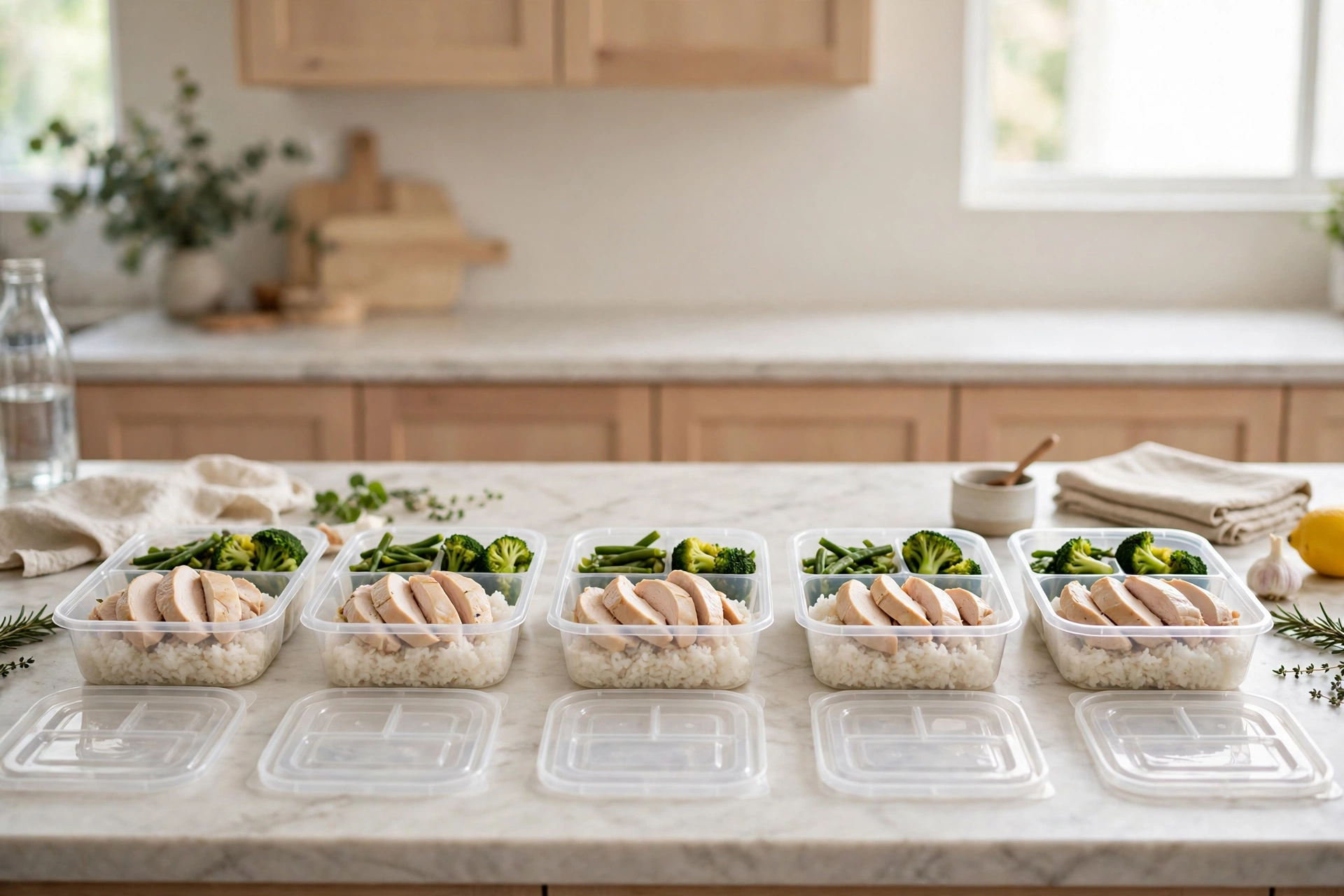
This is where the hero recipe earns its wages. Cook once — Sunday, in this house — and eat like a person all week.
Fridge rules, from the door of ours, where they’re held on by a magnet shaped like a strawberry: cooked chicken breasts keep for 4 days in a sealed container — the one with the blue lid that actually clicks, not the one we all pretend clicks. But here is the house rule: keep them whole.
Slice only what you are eating, at the moment you are eating it. A sliced breast dries out from every cut face, a little more each day. A whole one keeps its counsel and stays juicy to the last slice on day four.
Freezer, it behaves itself: breasts go in whole or sliced, doesn’t matter, into a freezer bag with the air squeezed out of it first — 3 months in there and it’ll still be itself when it comes out. Thaw in the fridge overnight, not on the counter in a bowl of warm water while you hope for the best.
Reheating, and be gentle or don’t bother: a covered dish, 1 tablespoon of water sprinkled over, 160°C (320°F) for 10 minutes, just until warm right through. It was already cooked — you are waking it up, not cooking it again. Blast it in the microwave on full and you will re-create the squeak. If the microwave is genuinely all you have: half power, short bursts.
And where does it all go, in a normal week here? Sliced over salads. Into sandwiches with the mayo that costs too much and is worth it. Diced into Friday’s fried rice.
Shredded into my chicken noodle soup on the days the shop has no thighs — and this chicken is juicy enough that nobody at the table has ever once complained, including me. And one breast, whole, goes in a tub over the road to Mrs. Okafor, who returns the tub washed, with opinions, and once — memorably — a single perfect tomato, no explanation given, none needed.
A Last Word
Chicken breast has a reputation problem it didn’t earn. The bird is not boring. The bird was just being cooked by guesswork — by me, by most of us, by everyone who ever added five more minutes for luck.
Brine it. Level it. Measure it. Rest it.
Four small kindnesses, none of them expensive, and the punishment food of the last twenty years turns into the thing your family asks for by name — my daughter included, who now requests “the non-squeaky one,” which is the highest honour this kitchen bestows.
Some recipes are for celebrations. This one is for Tuesdays. Good Tuesdays.
