
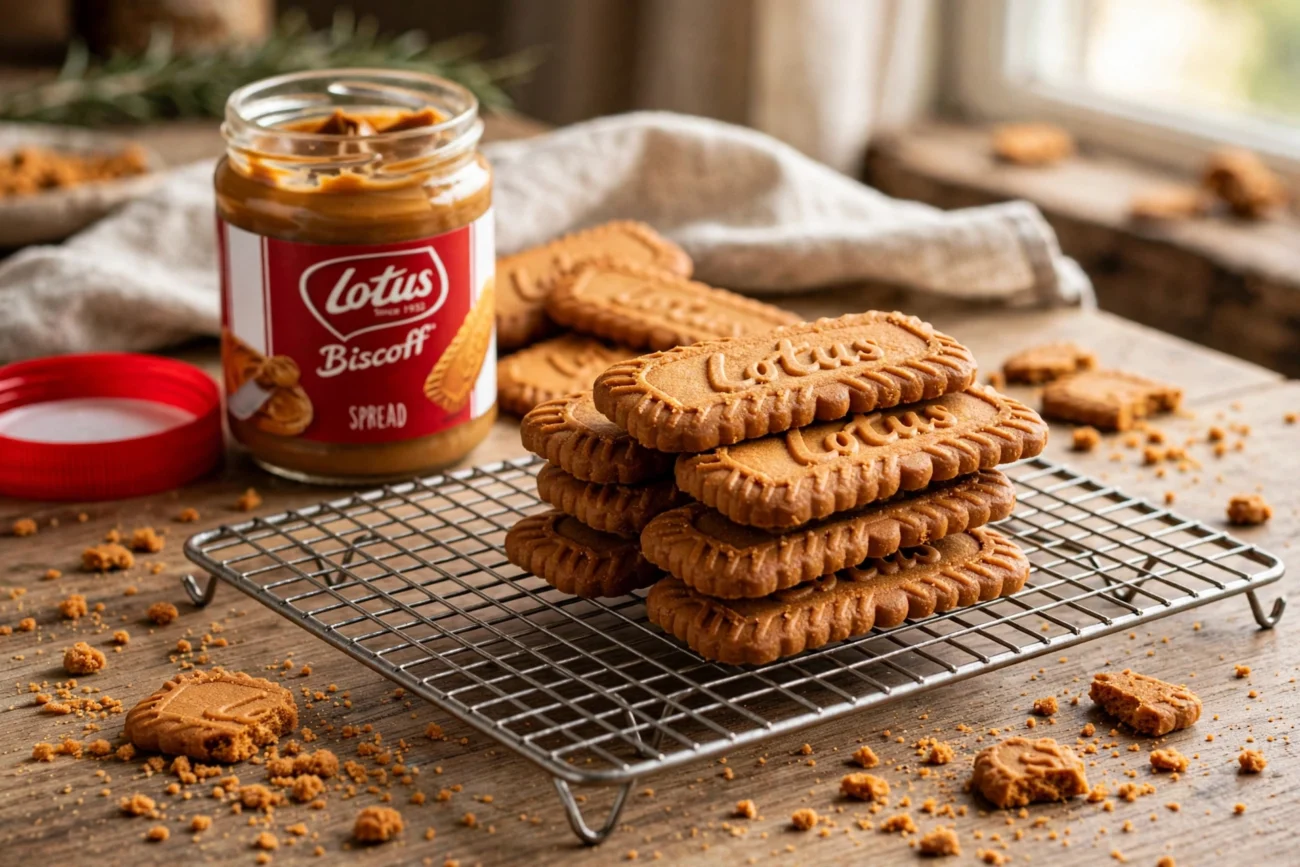
It started with a jar I bought for no reason I could defend.
You know the little spiced biscuit that turns up next to a cup of coffee, in the wrapper, looking like it wandered in by accident? That biscuit, but as a spread.
Brown jar. Innocent looking. I stood in the shop arguing with myself — we did not need it, there was no plan for it — and bought it anyway, which is how all the best and worst kitchen stories in this house begin.
Tuesday night, half eleven, I came down for water and found my husband at the counter with a teaspoon, eating it straight out of the jar like a man defusing something.
“It’s basically a biscuit,” he said. “It doesn’t count.”
It counts. It particularly counts at half eleven, with the small spoon meant for the sugar bowl.
By breakfast my daughter had found it, and there were negotiations. Actual negotiations. Over toast. Somewhere between her asking why we never just make the biscuits into cookies, “proper ones, with the crunchy bits still in,” and me realising the jar was going down at a rate that suggested intervention, this recipe happened.
What came out of it — the second attempt, the one where I actually followed my own notes — was a cookie that bends in the middle instead of snapping (my husband folds his in half before eating, like a man with a system), edges gone properly crisp, almost lacy, and the crushed biscuits not sprinkled on as decoration but folded right through the dough, so you hit a bit of crunch in basically every mouthful, including the small corner piece my daughter claims as tax.
The first batch had a disaster in it. There is a section. There is always a section.
Why These Cookies Work
Because the biscuit itself is — I read the packet in the shop queue, which is how much time I had — mostly caramelised sugar and warm spice, that cinnamon-ginger thing, and the spread is just that same flavour loosened into something you can actually stir into a dough with a wooden spoon. The cookie doesn’t have to work hard to taste of something — it’s all already there.
The chew — the proper chew, the one that made my daughter stop mid-bite and nod — traces back to two things: butter that’s been melted in the pan rather than beaten soft, and not being shy with the brown sugar. Melted, not softened. I have done both, and softened butter gives you a polite cakey little dome of a cookie — fine, forgettable. Melted gives you the one that bends before it snaps.
And the crumbs. This is the part I will not be moved on.
Most of the crushed biscuits — not all, and this split matters more than it sounds — go into the dough itself, so the rubble is baked all the way through and you can’t take a bite without meeting some of it.
The handful left over gets pressed onto the tops, where the oven toasts it darker and crunchier than the bits inside. I tried an all-soft version once, no crumbs anywhere, and my husband ate two and said, quite kindly, that it was basically a cake. These have edges. These have opinions.
Timings, because somebody — it was my husband, texting from the sofa, jar lid in his other hand — always asks: about 20 minutes of pottering around, then at least 1 hour of chilling, overnight if you can stand the wait (it’s better, annoyingly), and 12 minutes in the oven. On paper the batch makes about 20 cookies, which ought to be four days’ worth. In this house the tin was at half by the end of day two.
What Goes In — a Shopping List Said Out Loud
- 225 g (1 cup / 2 sticks) unsalted butter — melted, then left to cool for 10 minutes, because hot butter cooks the egg and scrambles your afternoon
- 200 g (1 cup, packed) soft light brown sugar — packed properly, pressed down with the back of the spoon
- 100 g (½ cup) caster sugar — the white one, for the crisp edges
- 200 g (about ¾ cup) smooth Biscoff spread — for the dough itself, and yes, weigh it, “half the jar” is not a measurement, whatever my husband claims
- 1 large egg plus 1 egg yolk, at room temperature — the extra yolk is the chew, keep it
- 2 teaspoons vanilla extract — the real one if you have it
- 300 g (2½ cups) plain flour — spooned and levelled if you’re measuring by cups, not scooped
- 1 teaspoon bicarbonate of soda — level teaspoon; check the box isn’t ancient
- 1 teaspoon fine sea salt — it is not too much, it is the whole point
- 1 teaspoon ground cinnamon — the biscuits bring spice; this turns the volume up
- 140 g Biscoff biscuits, about 18 of them — crushed rough, some rubble, some near-dust; roughly two-thirds for the dough, the rest saved for the tops
That is the lot. Nothing exotic. The jar does all the showing off.
How It Actually Goes
- Butter first. Melt it in a pan or a jug in the microwave, whichever, and then — this matters — walk away for 10 minutes. It wants to be warm and liquid, not hot. Hot butter plus egg equals sweet scrambled eggs. There is no rescuing that.
- Big bowl — the one with the chip on the rim, in our house. Both sugars in, warm butter poured over the top, then whisk the lot until it stops looking like two separate things and turns into something closer to wet sand, the kind that holds a castle shape for about a second. Then the Biscoff spread goes in, all 200 g of it, weighed, and you whisk again until the streaks are gone and it’s one even, glossy, caramel-coloured sludge (it does not look like food yet; trust the process).
- Egg in. Yolk in after it. Whisk again until it properly shines. Vanilla last, quick stir.
- Flour, bicarbonate of soda, salt and cinnamon straight on top, and at this point put the whisk down and step away from it, because a whisk worked through dough this thick just tears it into toughness [my husband once “helped” at exactly this stage; we do not discuss the texture that followed]. Fold with a wooden spoon or a spatula, slow and from the bottom, until you can’t see flour any more and not one stroke further. Overworked dough is tough dough.
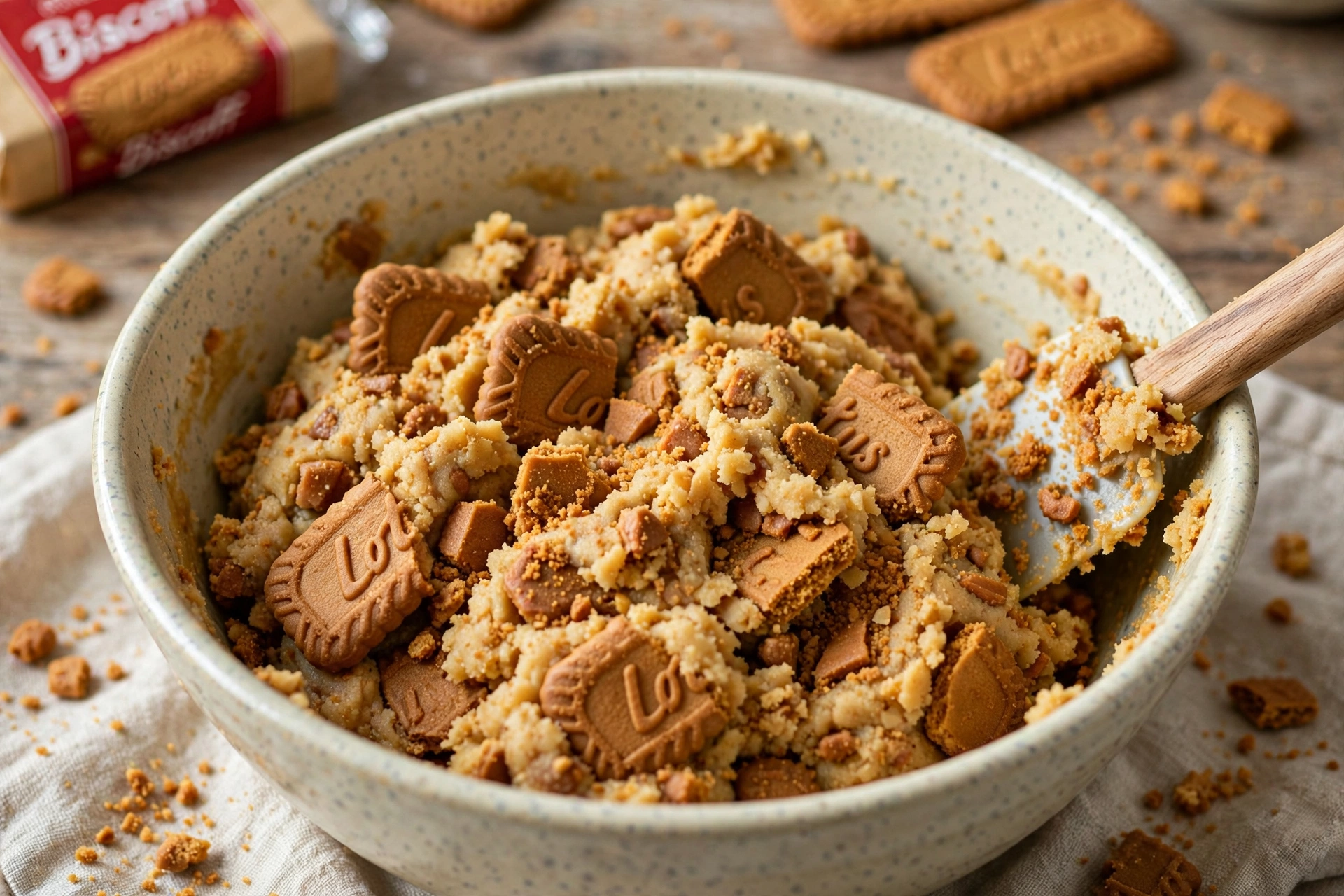
- The crushed biscuits — the two-thirds portion — folded through last of all. You want them distributed, not demolished. Chunks should survive.
- Now. The bowl goes in the fridge.
One hour. Minimum. Overnight if your life allows it — the dough keeps happily for up to 2 days in there, covered. Make-on-Sunday, bake-on-Tuesday, if you play it right.
I can hear the groaning. I groaned too, first time, and baked them straight away to prove a point — the point proved itself all over the tray. That disaster has its own section below.
The chilling is not fussiness. Think about what’s actually in the bowl: butter that was liquid an hour ago, and a spread that is, let’s be honest, mostly fat and sugar held together by optimism — leave a dough like that sitting warm on the counter and it slumps, it has no more structure than the batter for the pancakes my daughter refuses to discuss. An hour in the cold changes the physics of it.
The fats set firm again, properly firm, you can feel it when the scoop resists, and meanwhile the flour has been quietly soaking up moisture the whole time, so the flavour comes out the other side deeper. Spicier. Darker. The batch I left overnight — Tuesday’s dough, baked Wednesday morning — honestly tasted like it had been somewhere and learned something.
- Oven on: 175°C (160°C fan / 350°F / Gas Mark 4). Trays lined with baking paper. Dough out of the fridge — cold, it fights the spoon a bit, which is correct — scooped into balls of about 60 g each. In practice that is a heaped 3-tablespoon scoop, and after weighing the first two to calibrate my eyes I gave up and eyeballed the rest, same as everyone. Space them out properly, a good 5 cm between each one, and no more than 8 to a tray, whatever my daughter says about efficiency.
Then the tops: take a pinch of those reserved crumbs — the ones you set aside and didn’t fold in — and press them onto the top of each ball with your thumb, like you’re sealing something small and important. Gently. You’re decorating, not performing CPR.
- Bake for 11 to 13 minutes.
Watch for this: edges golden and set, looking like they have their lives together, middles still pale, puffed and — I know how this sounds — slightly underdone looking. Soft in the centre. A bit wobbly if you nudge the tray.
That is not underbaked. That is tomorrow’s chew, arriving on schedule.
Leave them a full 2 minutes longer “just to be safe” and the middles set into ordinary biscuit territory. Not what we are here for.
- Out of the oven, tray down, and it stays down. Ten minutes. Do not touch them. They are finishing cooking in the tray’s heat and firming up at the edges, and a cookie moved too early folds in the middle. Then onto a rack.
The Mistake I Made First
The cookie carpet. We do not speak of it fondly, except constantly.
First attempt, I skipped the chill — impatience, pride, pick your poison — and also stirred in an extra heaped spoonful of spread for luck, because more of the good thing is more, isn’t it. It is not. Baking, I have learned the expensive way — the way involving a tray that needed soaking overnight — does not care about your intentions; it cares about ratios and temperature, and it keeps receipts.
The dough went into that oven warm, never chilled. Extra fat. Hot oven.
Reader, they spread.
Every cookie reached for its neighbour like they were reuniting at an airport, and what came out of my oven was one single tray-sized cookie with twenty ambitions. A biscuit duvet. I stood there, oven glove still on, having a small personal crisis, then cut the whole sheet into rough squares with the pizza wheel while it was still warm, serving them up as if squares had been the plan all along.
My daughter, who had watched the whole production with her chin in her hands, ate three of the squares standing at the counter — still warm — announced that they were Biscoff slabs now, “like the ones from a café, but flat,” and then, crumbs on her jumper, asked when I was making them again.
So the fix is not some new technique — it’s just the recipe above, done without the improvisation: weigh the spread like the packet means it, no blessing the bowl with an extra spoonful for luck (I have run that experiment; the results are in the paragraph above), chill for the full hour and overnight when the day allows, give the balls their proper space, and let a used tray go properly cold before it takes another load, because dough set down on a tray still hot from the oven starts melting before the door is even shut.
Do those things and they bake up thick, rippled at the edges, soft in the middle. Don’t, and you own a duvet.
Three Ways to Bend It
Stuffed
Stuffed, for people who have no interest in moderation.
Spoon 12 level teaspoons of Biscoff spread onto a lined plate — teaspoons, mounded slightly — and freeze them for 30 minutes until they’re firm little coins. Then, working quickly because frozen spread waits for no one: flatten each 60 g ball of the chilled dough in your palm, sit a coin in the middle, and fold the dough up and over it, pinching the seam shut all the way round — any gap and the middle makes a break for it in the oven. Bake them the normal way, same temperature, same tray, just 1 extra minute on the clock, on account of the cold centre. The middle stays soft and spoonable long after the cookie has cooled, which is either a triumph or a hazard.
Drizzled
Drizzled, for showing off to people you’ve decided to impress.
Melt 2 tablespoons of spread — 20 seconds in the microwave in a little jug, stir, it goes pourable and glossy — and zigzag it over the cooled cookies with a teaspoon. A pinch of flaky sea salt over the wet drizzle. Around here, we are that person.
Sandwiches
Sandwiches, for high summer and low standards of behaviour.
Two cooled cookies, a fat spoonful of spread (or, scandalously, a small scoop of vanilla ice cream) spread thick between them, pressed gently until it just reaches the edges. Ten minutes in the freezer to set. Eat outside, standing up. Dripping is guaranteed.

Leftovers: the Tin, the Freezer, and Bringing Them Back
What’s left — and I say this in full knowledge of the midnight spoon situation — keeps in an airtight tin for 4 to 5 days. They soften gently as the days go on, and by day three they have become, in my private opinion, the perfect dunking cookie. Chai, in this house. A five-second dunk, no more, this is a biscuit with structure, not a sponge.
Dough freezes beautifully. Balls rolled, on a tray in the freezer until solid — an hour or so — then into a bag or box where they’ll keep for up to 3 months. Bake from frozen at the same temperature, 2 extra minutes, and you are a person who produces warm cookies on a Wednesday with no build-up whatsoever. Mrs. Okafor over the road received a bag of these frozen balls and reported back through the fence, holding one, that it was “dangerous information to give a neighbour.”
Baked cookies freeze too, up to a month, wrapped well, though the edges lose a little of their fight. Revive any cookie that’s gone soft or sad with 5 minutes in a warm oven at 150°C (300°F), or 10 seconds — ten, counted out loud — in the microwave for a chewy middle in emergencies.
A Last Word
Make them for the person who eats the spread with a spoon at midnight. Make them for the negotiator at your breakfast table. Make them the day the jar appears in your cupboard for reasons nobody will fully explain — and bake them before it empties itself one teaspoon at a time.
Some recipes are just biscuits. Others move into the tin and start paying rent.
