
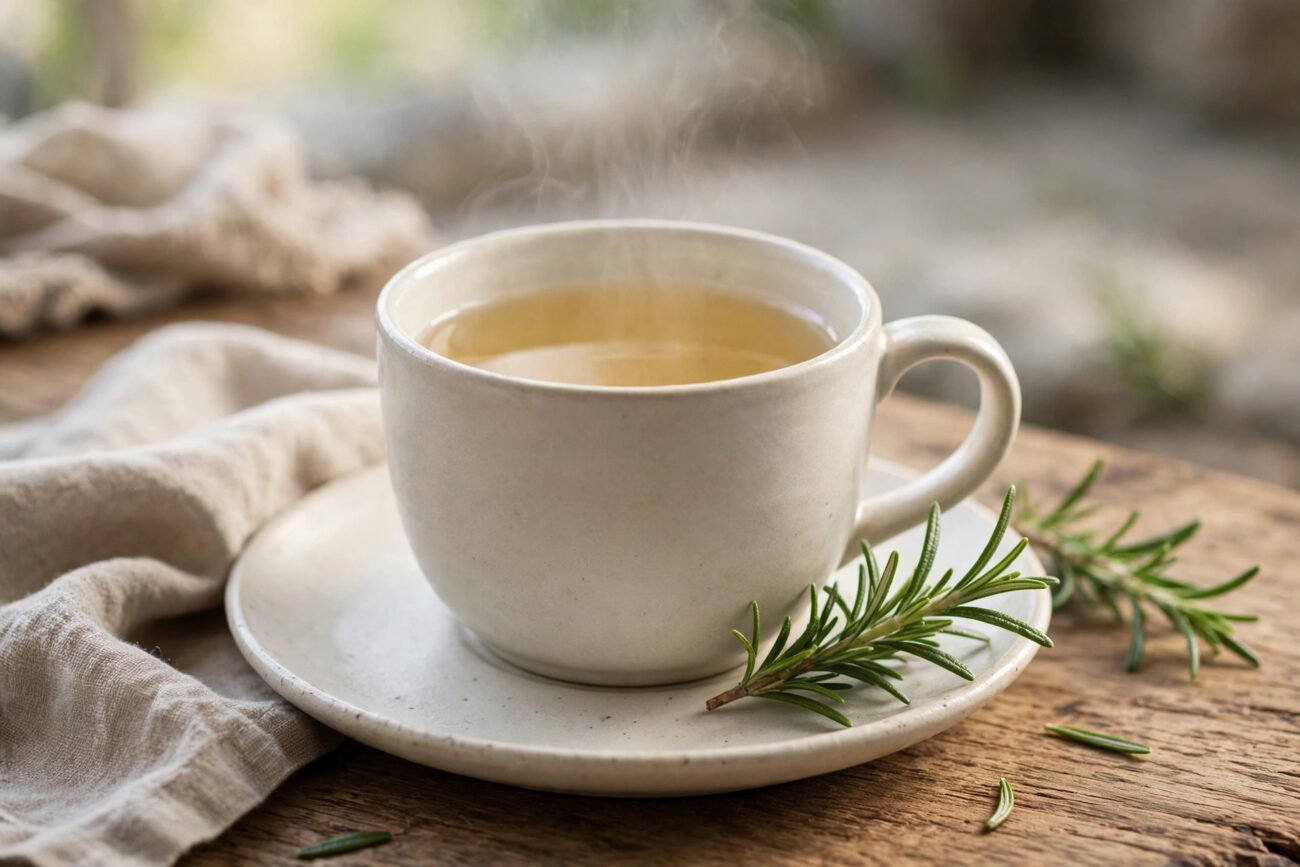
One seedling is what I planted. One. In a pot — a small pot, a sensible pot, the kind of pot a reasonable person buys — because I thought, roast potatoes, that’s it, that’s the whole plan, a sprig here and there and we’re done. That was years ago. I want you to hold that image — one seedling, one pot, one reasonable person — because the rosemary is now a hedge with opinions. It has swallowed the corner of the garden entirely. It flowers purple in spring, the bees adore it, they hold conventions in it, and I could trim it weekly — weekly — and still never make a dent. Roast potatoes alone were never going to use this much rosemary. It was a maths problem from the start and I refused to see it.
So I started putting it in everything I could justify, and a few things I couldn’t, and we don’t talk about the rosemary shortbread incident — and the simplest of all of them turned out to be the one I make most: tea. Just the herb and hot water; that is the entire ingredients situation. It tastes the way a walk past the bush on a warm evening smells — piney, savoury, cosy — and on a cold night, in a big mug, it has become my end-of-day ritual, the full stop at the bottom of the day. If you do not have a garden hedge with ambitions, a supermarket bunch or a jar of the dried stuff does the job perfectly well. The hedge is optional. The hedge, frankly, is a lot.
Why You’ll Love This Recipe
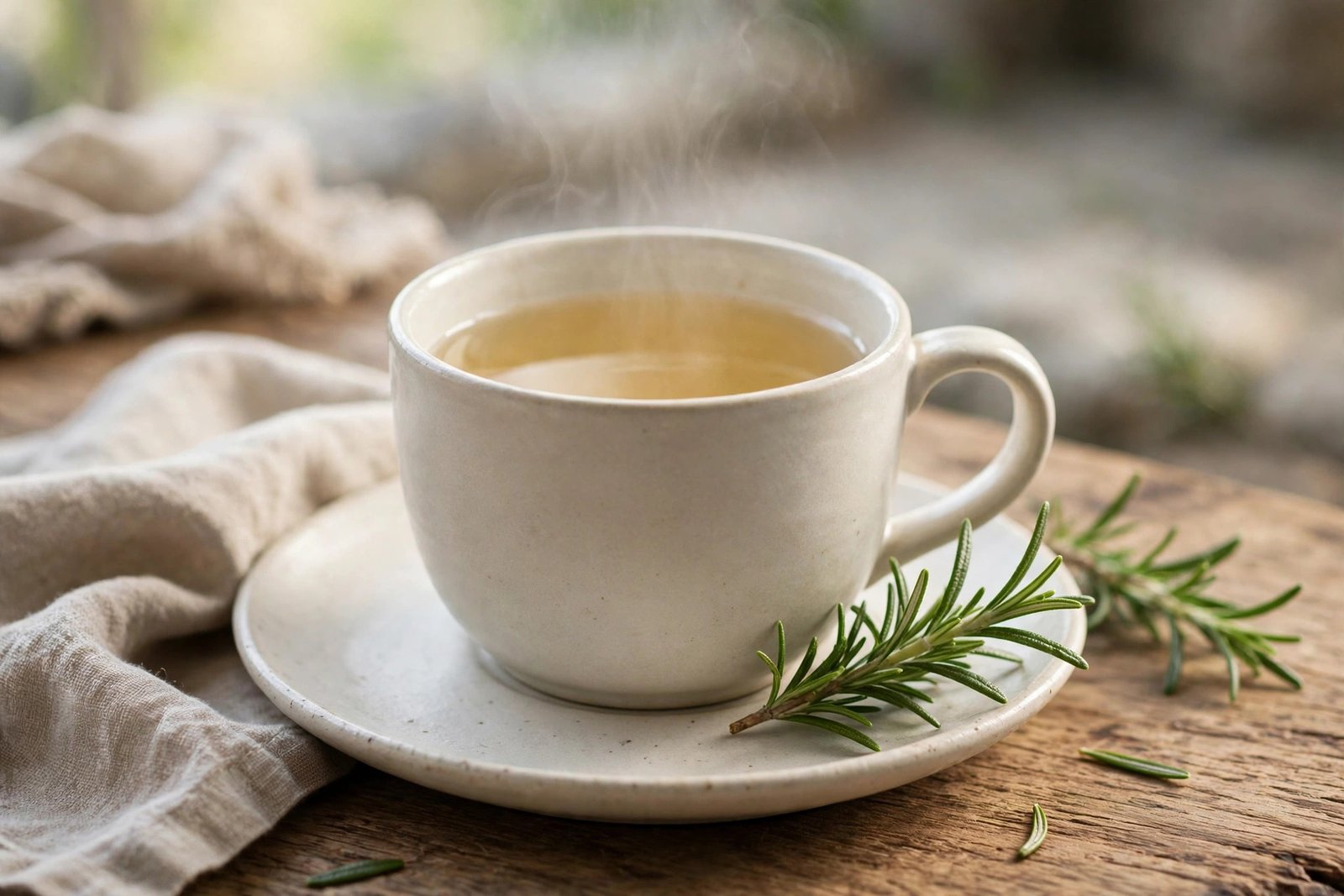
There is something deeply satisfying about making a drink out of a plant that is already in the garden, or already in the spice drawer going soft at the back. The ingredient cost is basically the price of boiling a kettle. I have made more expensive mistakes before breakfast, most of them involving the hedge.
It is caffeine-free and savoury rather than sweet, which makes it a good change from the usual evening drinks — there is a limit to how much cocoa and chamomile one person can rotate through before the evenings start to blur into each other. And it is forgiving: rosemary is one of the strongest herbs there is, so a sprig more or less, a minute longer in the pot, none of it ruins anything. There is, however, a line. We will get to the line. The line matters.
Ingredients
- 2 to 3 fresh rosemary sprigs, each about 4 to 5 inches (10–12 cm) long — or 1 teaspoon dried rosemary
- 2 cups (480 ml) water
- Optional, to serve: honey, a slice of lemon, or a thin strip of lemon peel
That is the whole list. Three lines. I have written longer shopping lists for a sandwich. If your rosemary comes from a garden, pick it in the morning if you remember — the oils are strongest then — though honestly the difference in a cup of tea is small, and I usually pick it whenever the kettle goes on, which is to say in the dark, in slippers, negotiating with a hedge.
Step-by-Step Instructions — The Kettle Does Most of This
- If you are using fresh, rinse the sprigs briefly under cold water to wash off any garden dust — a quick pass, not a soak — and give them a shake over the sink. If you are using dried rosemary, skip all of that entirely; just measure out your teaspoon and feel efficient.
- Now bruise the fresh sprigs lightly — roll them between your palms a few times, or twist them gently, the way you’d wring out the world’s smallest towel, because you are not mangling them, whatever it looks like, you are waking the oils up, and you will smell the difference immediately, it is not subtle. It goes from “herb, vaguely” to rosemary, unmistakably, all at once.
- Water into a small saucepan and bring it to a boil. This is the high-effort part of the recipe and it is boiling water, so we are all going to be fine.
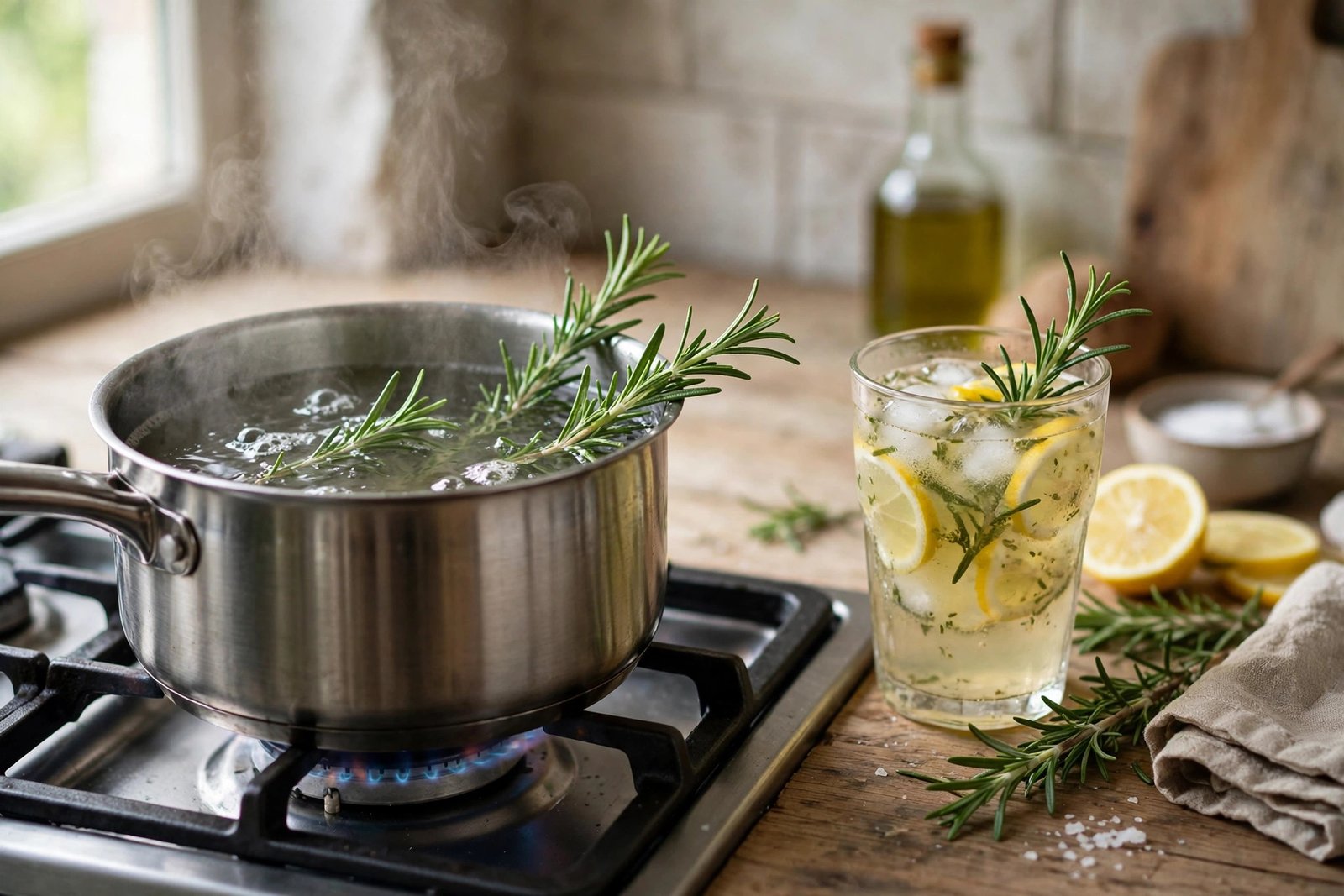
- Rosemary in, heat right down, and let it simmer gently for 5 minutes. The water will take on the faintest green-gold tint — you have to look for it, it is shy — and the kitchen will smell wonderful, like a roast dinner is happening somewhere nearby that you are definitely invited to.
- Pan off the heat, lid on, and let the tea steep for another 5 minutes. Taste it at this point — go on, spoon, sip, it is allowed — because the total sweet spot for most people is somewhere between 5 and 10 minutes of contact with the water, and your spot is in there somewhere, and only tasting will find it.
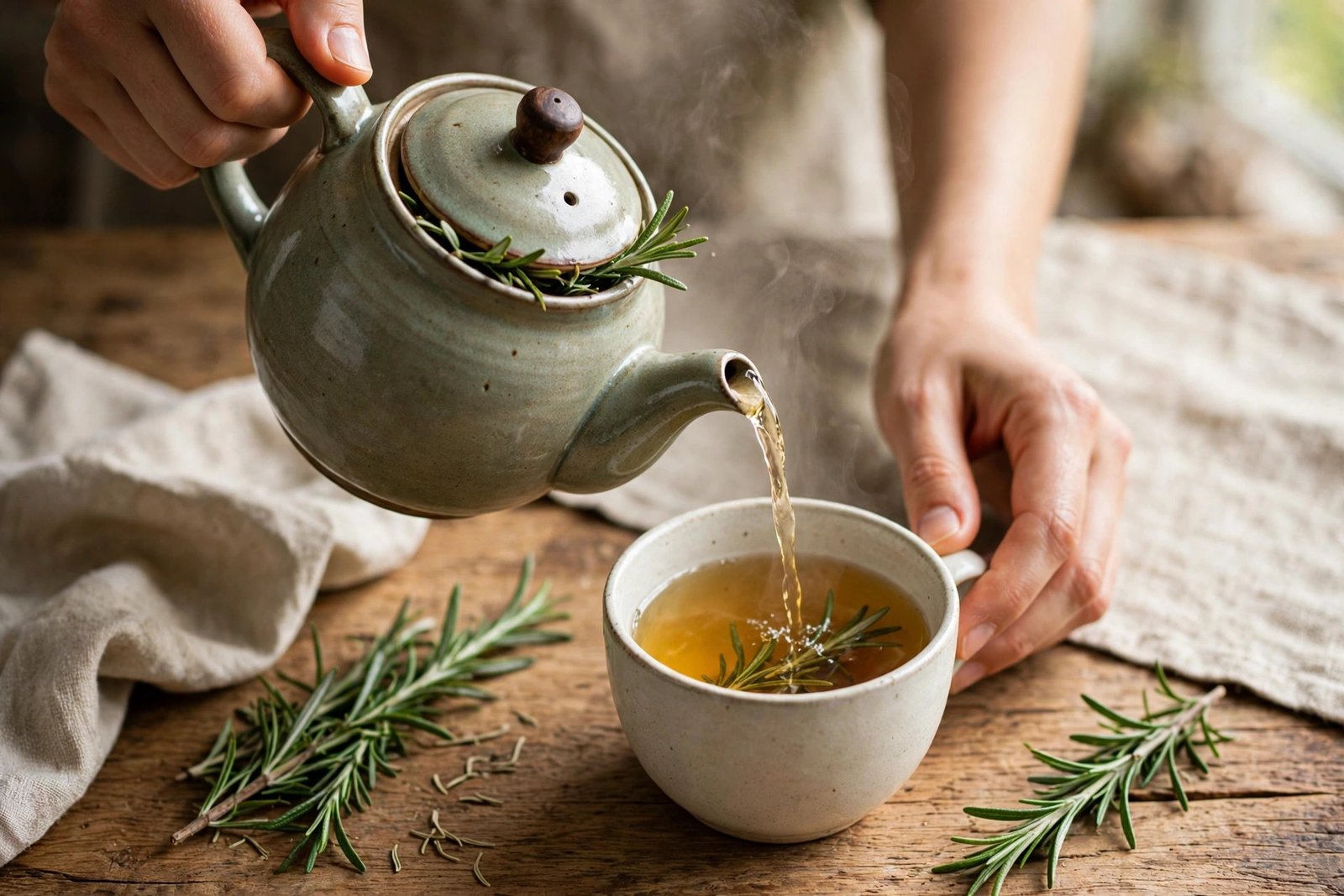
- Strain it into mugs, through a small sieve or a tea strainer, to catch the needles — a few strays in the cup do nobody any harm, they bob about harmlessly enough, but a mouthful of them is not the experience we are after, so strain like you mean it, because apparently I do have to say that.
- Honey or lemon if you like — plain is lovely, plain is my default and my default is rarely wrong, but a strip of lemon peel dropped in while it steeps is my personal favourite, because it lifts the whole cup, brightens all that piney depth, makes the tea taste awake rather than merely warm.
- Sip it hot. That is it. Tea made. From a hedge, in my case. If you have the hedge, you may feel smug at this point. It is earned.
Tips and Common Mistakes — Mostly About Restraint
- The line I mentioned is, mostly, time — because rosemary left steeping for twenty minutes or more turns medicinal, bitter and piney, like drinking the Christmas tree, and not in a festive way, not in any way you’d repeat. If you like it strong, use more rosemary for a shorter time rather than the same sprig punished for longer. That one change — more herb, less time — fixes almost every disappointing cup I have ever heard about, including my own early ones, which were basically forestry in a mug.
- More is not better with this herb — it is barely better with most herbs, and with rosemary it is actively worse, because a heavy hand gives you a tea that tastes like roast lamb seasoning, which is a fine flavour on lamb and a deeply confusing one in a mug, so start with the amounts given and adjust next time if you want it bolder, and there will be a next time, there is always a next time, the hedge sees to that with a diligence I could learn from.
- Use only rosemary that is meant for eating — garden-centre plants are sometimes sprayed with things you do not want in a mug, and a neighbour’s decorative rosemary by a busy road has been collecting exhaust fumes its whole life, it is essentially a traffic herb at this point, a commuter — so if in doubt, buy the culinary kind, a fresh bunch from the supermarket herb section, which costs very little and then lasts ages in the fridge, wrapped up and unbothered, much like the gardener.
- Dried rosemary is a different creature from fresh — more concentrated, a little less bright, more pine forest and less garden evening, if we’re being poetic about a spice jar — and one teaspoon of dried roughly equals the sprigs listed, so measure it like you mean it; and if your dried rosemary has been open for a year (check the jar, I will wait, I have nowhere to be, the hedge isn’t going anywhere) it will still make tea, just a duller one, so use a pinch extra and manage your expectations kindly, the way you’d manage a relative.
Variations and Substitutions — The Hedge Provides Options
Rosemary and lemon: two or three strips of lemon peel go into the pot with the rosemary — peel only, no white pith, because the pith is bitter and will make itself known, it always makes itself known, it has no off switch. Bright, clean, and it is the version I serve to people who think herbal tea is boring. It has converted several. I keep count.
Rosemary and ginger: a few slices of fresh ginger simmered alongside makes a warmer, spicier cup — the one I make when a cold is going around the house and everyone is feeling sorry for themselves and requiring beverages to be brought to them like invalids in a novel.
Iced rosemary tea — this one is easy, honestly. Make it double strength. Twice the rosemary, I mean, not twice the patience. Let it cool right down, then over ice it goes, with a long strip of lemon peel — long, a proper strip, not a little nub — and a fresh sprig stuck in for looks, because looks, apparently, are half the flavour. Unsweetened, it is brisk. Grown-up, even. Very “I have my life together,” which — I don’t, not remotely, but the tea has no way of knowing that. Stir in a spoon of honey syrup, though, and guests start asking. They always ask. And then you get to say “oh, it’s just rosemary tea,” all casual, offhand, just like that, which is a pleasure all by itself, it really is.
Blend it: half rosemary, half mint — fresh leaves added at the steep, not the simmer — is gentler and very good cold. And rosemary with a chamomile tea bag is the sleepy evening version, the one for the last hour of the day, when the hedge is asleep too. Probably. I have not checked. It might never sleep.
Serving Suggestions
This is an after-dinner tea in my house. The savoury, herbal flavour settles things after a rich meal the way mint tea does — that clean, everything-is-fine feeling — and a small plate of shortbread or almond biscuits alongside is never unwelcome. The shortbread is not required. The shortbread is also never refused.
It is also, slightly unexpectedly, an excellent desk tea — no caffeine, so no 3 a.m. regrets, but enough flavour that you do not feel you are drinking punishment water, which is what most desk teas taste of by the third cup. I keep a little jar of dried rosemary in the drawer for exactly this. Colleagues have asked about it. Colleagues have been converted by it. The drawer rosemary has a small following.

Storage of Leftovers
Leftover tea — jug, lid on, fridge. It keeps up to 3 days in there. No drama. None. The flavour softens a bit as it sits. The second day is mellower — softer round the edges — and the colour deepens, goes broodier, less bright. Third day? Still fine. Honestly fine. Especially poured over ice, where nobody is standing there analysing it anyway.
To reheat, warm it gently in a pan until steaming — do not boil it again. A second boil pushes it towards that bitter, over-steeped territory we are avoiding: all Christmas tree, no mercy. A microwave also works, if the pan feels like a commitment — heat it in short bursts and actually check, rather than setting it for ages and wandering off to negotiate with the hedge, which is a negotiation the hedge always wins.
You can also freeze it in an ice cube tray, which sounds like a tip from a magazine you didn’t buy, but the cubes are useful well beyond tea — drop them into soups, gravies, a pan of roast vegetables, and they leave a background note of rosemary that nobody can quite put their finger on, so that dinner guests end up saying “there’s something”, and there is something, and it is a tea cube, and you will say nothing, because some victories are quiet ones.
FAQs — From the Drawer-Jar Appreciation Society
Does rosemary tea contain caffeine — genuinely asking, it’s nearly bedtime?
No — none at all, not a trace, it is just an herb and water, the herb, the water, the kettle, the end, a cast of three, so you can drink it last thing at night with a clear conscience and an untroubled ceiling to stare at for other reasons. That is half its appeal. The other half is the taste, in case that needed saying.
Is fresh or dried rosemary better for tea — or am I overthinking a cup of tea again?
Fresh, if I had to describe it — brighter, softer round the edges, more garden. Dried is the louder one, piney, it walks in first. And both of them make a proper cup, honestly they do, just not the same cup — cousins of each other rather than twins. So: fresh if you have the plant — some of us have rather a lot of the plant — dried the rest of the year, and if it is dried you’re using, ease off slightly on the steeping time, because dried does not know its own strength and will happily over-deliver.
How much rosemary is too much — where exactly is this line you keep mentioning?
If the tea tastes bitter or medicinal — and you will know, your face will file the report before your brain does — you have either used too much or steeped too long, and it is usually the steeping, it is the steeping nine times out of ten, so stick to 2 to 3 sprigs per 2 cups of water and 5 to 10 minutes total and it stays smooth and pleasant, because those numbers are the guardrails, unglamorous as guardrails are, and inside them the tea behaves like it was raised properly.
Can I drink rosemary tea every day — because at this rate I will be?
In normal culinary amounts — this recipe, a mug, an evening, not a bucket of extract — rosemary tea is a common everyday drink for plenty of people, and I am, for the record, some of those people, daily, sometimes twice, in a way that started as using up a hedge and became a personality trait. As with any herb taken in large, concentrated amounts daily, one sensible note: if you are pregnant, or on regular medication, it is worth checking with your doctor first. I am a cook, not a clinician — the tea is lovely, but I am not making health promises for it. The hedge makes no promises either.
Can I sweeten it?
Of course you can — of course — and honey is the natural partner here, it just is, stir it in after straining, while the tea’s still hot, a teaspoon at a time, and taste as you go, don’t just commit, taste. Sugar’s fine too, if honey’s not your thing — no judgement, well, a little judgement, no, none — me, I take it plain most nights, plain is the default in this house and the default, once established, tends to win by seniority, and the honey cup is the treat cup, except the treat cup has been winning more evenings lately, which either means the tea’s getting better or I’m getting softer, and honestly, that’s between me and the hedge and neither of us is talking.
Nutrition — The Numbers, Such As They Are
Per cup, then. And by a cup I mean a proper mug, about 240 ml, not one of those thimble things. Unsweetened — right, unsweetened — it comes to roughly 5 calories. No fat. Carbs, oh, about 1 g. Caffeine? None. Sugar? None either. And look, these are estimates, only estimates, I keep saying it because it’s true. A drink you make at home doesn’t come with a label stuck on it. Somebody gives you exact numbers for a mug of hedge tea, all confident? They’re guessing. Confidently guessing, but guessing. Sweeten it, though — ah, then it changes. A teaspoon of honey, that’s about 20 calories, in it goes. Another teaspoon, another 20. That’s the whole maths of it, teaspoon by teaspoon, nothing fancier than that. And the rosemary itself, the actual herb in all this, goes in in such tiny amounts that the numbers barely twitch either way — this is flavoured water, basically, in the best possible sense, the flavour doing every bit of the work that the calories are not doing, which is most of the work, all of it really.
