

First, Let’s Talk About the Loaves That Failed
Right, before any recipe — the brick. If you’ve made gluten free bread before I’m willing to bet money yours did what mine did: came out looking, honestly, promising?? Smelled right, top golden, me feeling quite pleased with myself. Then the knife went in and — oh. Wet sponge at the bottom, crumbs everywhere, middle with the density of a building material.
First loaf, I ate a slice out of pure stubbornness. Second one I toasted, as if toasting fixes structural problems. Third one went out for the birds and this is not me being dramatic, the crows — professionals, they’ll eat a dropped samosa off a main road — pecked at it twice and left most of it. Even the birds filed a complaint.
So if yours failed, it wasn’t a talent issue. This bread fails for specific, boring, fixable, physics reasons, and most recipes just… don’t tell you?? They hand you the ingredients and wave. Autopsy first, recipe after — once you see WHY the brick happened, the recipe explains itself, promise.
What Usually Goes Wrong
1. There’s nothing doing gluten’s job
So gluten, in a normal loaf, is a net — it forms while you mix, all stretchy, and when the yeast gets going and blows its gas out, the net is what catches it, holds it in these little pockets, and pockets that stay put, that’s a rise, that’s the whole entire trick. Take the wheat away and the net’s just… gone. Gas still gets made — the yeast doesn’t know, nobody told the yeast — it just drifts straight out of the batter and the loaf sits there in the tin flat and dense and sorry. The stand-in that actually works, not the apologetic teaspoon some recipes sprinkle in to feel virtuous, is psyllium husk: it drinks water, turns into a gel, and the gel behaves near enough like the net that the pockets hold. Without it you’re out there fighting physics with a spoon, and I’ve run that experiment, repeatedly, and the spoon lost every single time.
2. The batter was too dry
This one fooled me for ages, and it fooled me because it looks wrong exactly when it’s right. Gluten free flours drink — way more than wheat, not close — so if your mix looks like proper bread dough, tidy, holds together, kneadable, respectable, that’s not the win it feels like, that’s a too-dry batter, and a dry batter can’t stretch around the gas, can’t rise, just sits there. What you actually want is thick cake batter. Wet. Sticky. Clinging to the spoon, to your fingers, to the concept of surfaces generally, while you stand there going surely not — yes, that, exactly that. Crumbly tight loaf at the end? This one. Money on this one.
3. One rise, then straight into a cold spot
Wheat bread taught you to knock back and prove twice — unlearn it, at the door, it will sabotage you here. This loaf gets ONE rise, no second proof waiting to rescue anything, and the window is fussy: too long and it over-proofs and collapses in the oven like a soufflé with regrets, too cold and it barely moves at all. Mine sat by a window in January for two hours once. Two. Hours. In January. It rose maybe a centimetre, I baked it anyway because hope is a disease, and that one fed the bin directly. Warm draught-free corner, about an hour, puffed up near the top of the pan — then oven. Not more time. The more time is the trap.
4. It was sliced too soon
The big one, this. If recipe cards had tattoos I’d put this on the card. The loaf is NOT done when it leaves the oven — inside, the crumb is still setting, still quietly finishing itself as it cools, it’s under construction in there — and if you slice it warm, which I have, at the one-hour mark, negotiating out loud like a hostage negotiator, just one slice, just to check, nobody will know — the crumb drags gummy on the knife and everyone blames the loaf, when the loaf is innocent and the only criminal is impatience. Two hours minimum. Overnight’s better. The gum will know. Wait.
5. The flour blend was mostly rice flour
A bag of plain rice flour, on its own, is not bread flour, whatever the bag’s tone implies. Alone it bakes gritty — properly gritty, sand-adjacent, beach-involved — and crumbly, because there’s no balance of starches in it, nothing softer in the mix to give the crumb any tenderness. You want a proper 1:1 blend, one where the thinking’s been done: tapioca in there, potato starch, maybe sorghum, maybe oat flour, a team, not a solo act. Mine’s the Bob’s Red Mill 1:1 in the blue bag, behaved every single time — but the brand isn’t the point, the starches are the point. The blend does half the work. Half.
The Recipe That Fixed It
Everything in the autopsy is baked into this one — psyllium doing the net job, batter properly wet, one rise only, and the cooling rule, which we do not negotiate. Make it exactly as written first time. Exactly. I say this as a person who substitutes things professionally — no improvising, then fiddle all you want on loaf two.

Ingredients
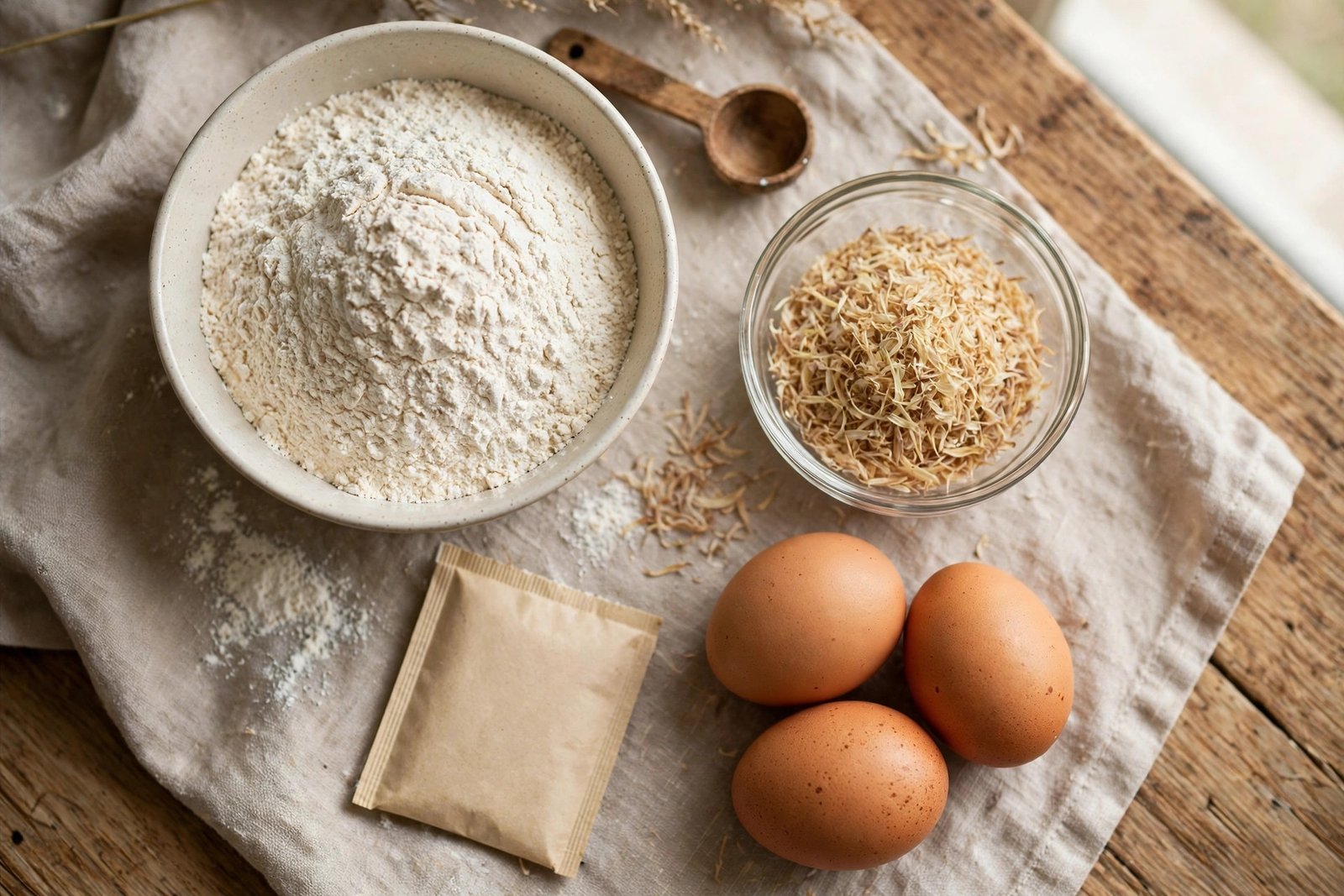
- 3 cups (about 420 g) 1:1 gluten free flour blend, one that contains xanthan gum
- 2 tablespoons psyllium husk powder (or 2 ½ tablespoons whole psyllium husk)
- 2 ¼ teaspoons instant yeast (one standard packet)
- 1 tablespoon sugar or honey — the yeast needs something to eat
- 1 ½ teaspoons fine salt
- 1 ¼ cups warm water, around 110°F / 43°C — warm like a bath, not hot
- 2 large eggs, room temperature
- 3 tablespoons olive oil or melted butter, plus a little extra for the top
- 1 teaspoon apple cider vinegar (helps the rise, and no, you can’t taste it)
Method
Bowl first, and the big one, because this batter climbs the sides like it’s escaping and a small bowl means wearing a percentage of your own loaf. Flour, psyllium, yeast, sugar, salt, all in together — then whisk it, properly whisk it, not the apologetic stir-the-top I did first time. Uneven psyllium is a trap: the second water hits a pocket of it, it clumps, and the clump sets into a jelly lump in the crumb, and you bite one mid-toast and your whole brain goes what is THAT. A psyllium clump. That’s what that is. Whisked. Moving on.
Second bowl — or in my house the big measuring jug, because the second bowl is always, ALWAYS in the sink — warm water, eggs, oil or melted butter, vinegar, whisked up into one thing and poured over the dry. Then mix, sturdy spoon or the mixer paddle, a full 2 to 3 minutes, timer on if your internal “that’s three minutes” is actually thirty seconds (mine is, I’ve checked, it’s thirty seconds). It’ll look like thick sticky batter falling off the spoon in blobs. Good. That IS good. Alarmed-but-thick is the target — do not add flour to fix it, that’s not fixing, that’s how bricks are born.

Now scrape — scrape, it does not pour, it clings to the bowl, the spoon, you, your whole afternoon — into a parchment-lined 9×5 inch loaf pan, and smooth the top with wet hands or a wet spatula, because dry hands stick and tear it and then you’re wearing batter gloves and swearing quietly at a tin. Little drizzle or brush of oil over the top, cover loosely, warm place, 45 to 60 minutes, until it’s puffed to roughly the rim — the rim, not doming proudly above it, doming is over — and somewhere in that window get the oven on to 375°F (190°C), hot and ready, not cold.
Bake 45 to 55 minutes and leave the door alone — shut, no peeking, the peeking is how the first problem in the next section happens. It should come out deeply golden on top, and tipped out and knocked on the bottom it should sound hollow; that knock has never lied to me, it’s the most honest relationship in my kitchen. Thermometer people: you want about 205–210°F (96–99°C) in the centre. Underbaked is the enemy — a pale polite loaf is a gummy loaf in a costume — so full time, no pulling it early because it looks done. Out of the pan, onto a rack, and say it with me: at least 2 hours before slicing, overnight if it’s for tomorrow, which in my house means hiding it from myself in the microwave (off, obviously, it’s a cupboard). Slice it warm and everything in section four happens to you. Tested. Extensively. Against my own advice.
If Yours Still Didn’t Work
It sank in the middle: over-proofed, nearly always — it puffed past the rim, got proud, and collapsed on itself — or somebody (no names) opened the oven early for a look; rise to the rim, not above it, door shut, that’s the whole fix. It’s gummy in a stripe along the bottom: same lesson, second verse — sliced while it was still warm inside, or pulled a touch underbaked; full bake, full cool, no negotiating with either. It crumbles when cut: dry batter or a weak blend, nine times out of ten — next time add a tablespoon or two more water, and check the bag actually has starches in it.
Storing It
In a bag at room temperature you get about 2 days — gluten free bread stales faster than wheat, that’s just its nature, not you, not the recipe, and honestly from day one this is a toasting bread in my house. And as one? Genuinely great. Crisp edges, soft middle, holds butter like it means it.
Longer than that, don’t leave it out to go sad — slice the whole loaf first, parchment between the slices so they don’t freeze into one bread iceberg you’ll be attacking with a butter knife at 7am, and toast straight from frozen, no thawing ceremony. It keeps about a month that way, and it’s the only way I bother, because a freezer slice toasted while half the house sleeps is more or less the entire reason I make this loaf. The failures weren’t random. Never were. They were physics — and physics, once somebody tells you the rules, can be worked with.
