
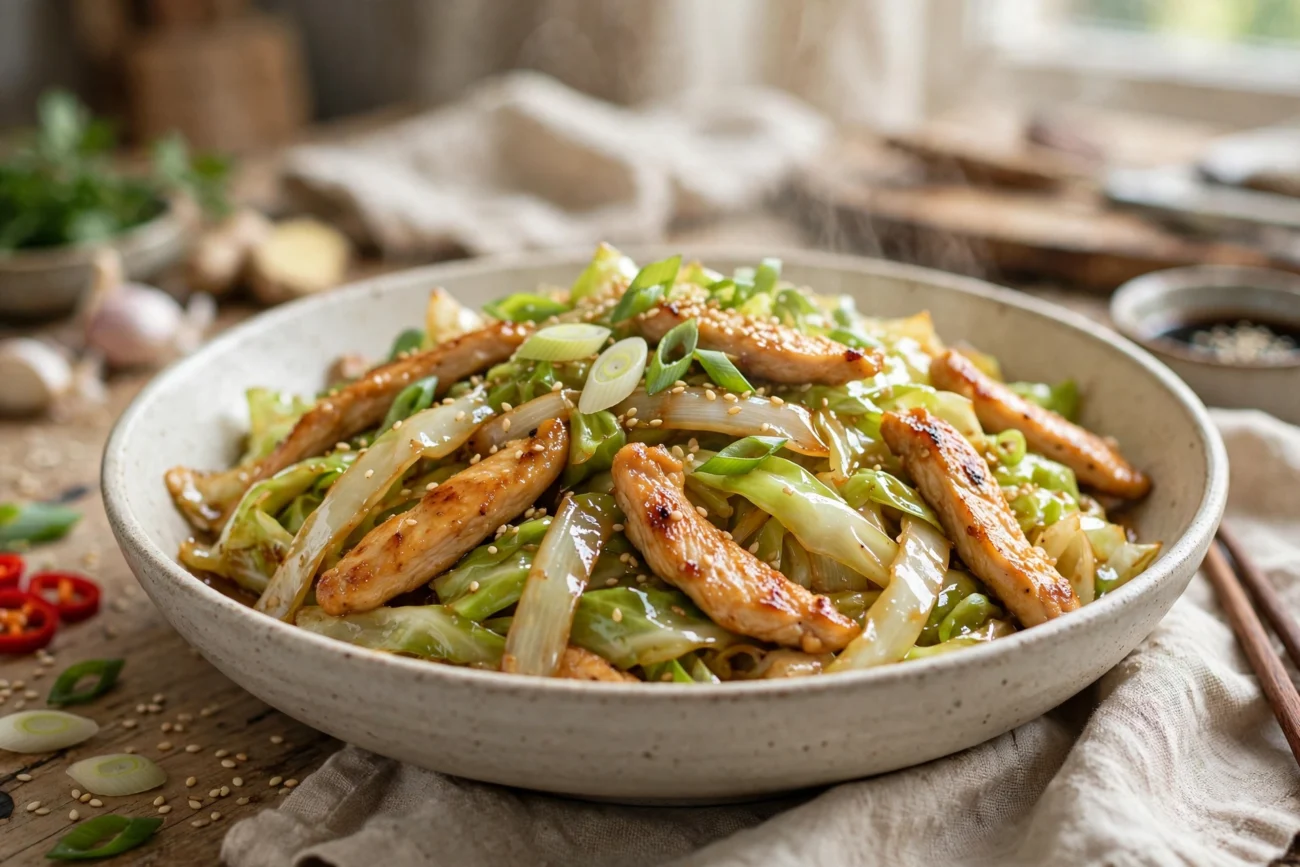
The cabbage had been in the fridge since Sunday, bought for a coleslaw. The coleslaw never happened — it is a weekend food pretending to be an everyday food — and by Tuesday we had eaten toast for lunch and called it a decision.
Tuesday, half past six, rain doing that thin sideways thing again. My husband came in, looked in the fridge, looked at the cabbage, and said the word in the tone of a man reading out a disappointing exam result.
“Cabbage?” he said.
“Cabbage,” I said, with more confidence than I owned.
My daughter drifted through, took one look at the chopping board, and announced she would be eating at a friend’s house on Friday. Friday. She was hedging three days early — though there was an earlier, wetter attempt at this dinner, confessed further down, and some of the suspicion is earned.
This version is not that version. This one is fast and glossy, the cabbage still squeaking when you bite it, the chicken with proper browned edges, done in 25 minutes. He had seconds. She ate the leftovers standing up the next day and denied it, fork still in her hand.
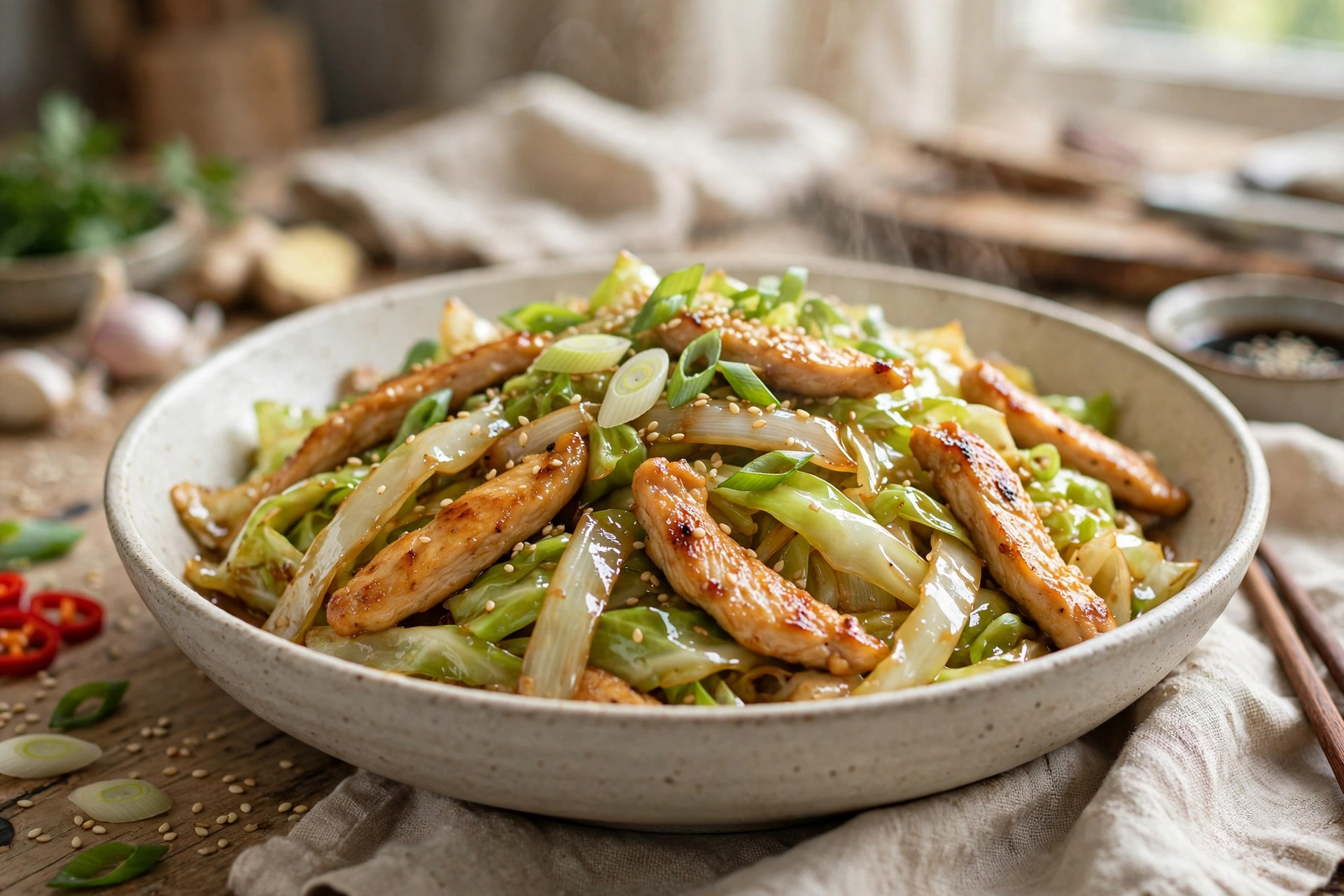
Why This Stir Fry Works
Heat and dryness. That is the whole sermon.
The cabbage has one job — stay itself, sweet and a bit stubborn, with charred edges where it caught the pan — and it can only do that job in a pan properly hot and not crowded, for minutes, not stewed into surrender.
So: chicken first, alone, in a single layer — crowded chicken steams, and steamed chicken is boiled chicken in a disguise. Out it comes. Aromatics next, thirty seconds of perfume.
Then the cabbage, all of it, in a pan so full it looks like a mistake [it slumps, give it a minute, it always slumps]. Then everything back together with the sauce — itself just soy, honey, rice vinegar and sesame oil: sweet, salty, sharp, warm from the chilli — for exactly one minute. Long enough to go glossy, too short to drown.
Timings: about 12 minutes of prep, about 12 minutes at the hob, on plates in 25. That panful feeds 4 with rice, or 3 if one of them is my husband, in whose philosophy rice is optional.
What Goes In — a Shopping List Said Out Loud
- 500 g (1 lb 2 oz) boneless, skinless chicken breast, sliced thin against the grain into strips about ½ cm thick — thin cooks fast and stays tender
- 1 teaspoon cornflour — the chicken’s overcoat; it helps the edges catch and gives the sauce something to hold on to
- 1 teaspoon soy sauce, plus a pinch of salt — for the chicken only
- 1 small green cabbage, about 700 g — core out, leaves sliced into ribbons a good 1 cm wide, thumb-width, not shreds [shreds are the enemy — see the mistake section]
- 2 tablespoons sunflower oil, or another neutral oil — split into two lots of 1 tablespoon
- 4 cloves of garlic, finely grated or minced — four, and we are not apologising
- 1 tablespoon finely grated fresh ginger — about a thumb, peeled
- 4 spring onions — whites for the pan, greens for the top
- ½ teaspoon chilli flakes — warmth, not a dare
- 1 teaspoon sesame seeds, to finish (optional)
And the sauce:
- 3 tablespoons soy sauce — the salty backbone
- 1 tablespoon runny honey — for the glossy, sticky edges
- 1 tablespoon rice vinegar — the sharp bit that lifts it [lime juice works if the bottle is empty, and mine was, the first time]
- 1 teaspoon toasted sesame oil
- Black pepper, and do not be shy with it — I grind until my wrist starts complaining, which my husband calls seasoning and I call therapy
And something underneath it all when it lands — rice or noodles, rice in this house nine times out of ten, in the big bowls with the chipped rims that we all pretend not to have favourites about.
How It Actually Goes
- Chicken first. Strips into a bowl, cornflour over, the teaspoon of soy, the pinch of salt, mixed until every strip looks faintly dusty. Set aside for 10 minutes — exactly how long the cabbage is about to take you.
- Cabbage next. Core out — quarter it and slice the hard triangle away, it knows what it did. Then slice the leaves across into ribbons about 1 cm wide. Ribbons. Wide ones. If you can read through it, it’s too thin. Sauce goes in a mug now, too.
- Biggest frying pan you own, or a wok, onto your highest heat until it’s nervously hot — a faint wisp of smoke is the pan clearing its throat. First tablespoon of oil in, swirl it, chicken in, spread out in one layer.
Then — and this is the hard part — leave it alone for 2 full minutes. Do not poke it. Do not shake the pan like a parcel. That stillness is where the browned edges — half the flavour of this dinner — come from. - Now stir it, toss it, give the pale sides their turn, another 3 to 4 minutes, until golden at the edges and white all the way through when you cut into the fattest one — no pink, juices clear. Five to six minutes in the pan all told. Out onto a plate, juices included — they come back later.
- Same pan, still hot — do not wash it, those browned bits are evidence — second tablespoon of oil in. Then the spring onion whites, the garlic, the ginger, the chilli flakes — the whole noisy lot of them, all at once, in a heap, because there is no time in a pan that hot for polite introductions. Thirty seconds, kept moving the whole time. The smell tells you when it’s ready — raw and sharp one second, round and warm the next. Past thirty seconds, the garlic burns bitter, and there’s no talking it out of it.
- Cabbage. All of it. In.
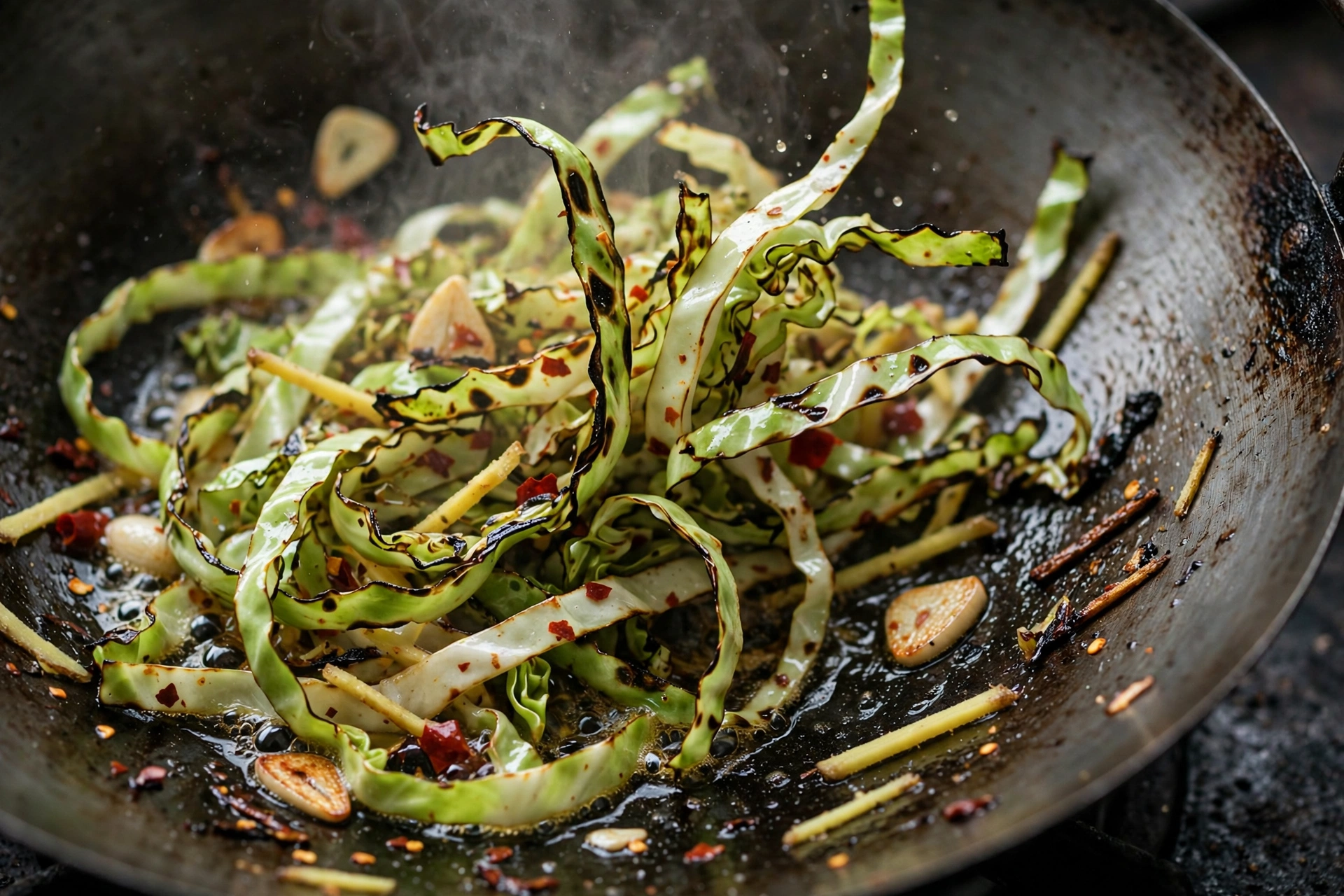
It heaps up like it’s trying to climb out — a small green mountain range in a frying pan — and for a good ten seconds you’ll stand there, spatula hovering, thinking no, absolutely not, there is no version of events where all of that fits in there. Get it tossed through the aromatics, the garlic and ginger clinging on wherever they happen to land, then spread it out flat-ish and — hands off, this is the hard part again — leave it completely alone for 1 minute, so the layer underneath gets its chance to catch on the hot pan and go properly charred in spots.
Toss again. Another 2 to 3 minutes — 3 to 4 minutes in the pan all told — until the ribbons are slumped, glossy and bright, the thick white ribs just translucent at the edges, but the whole lot still with fight in it.
Bite a piece. It should squeak, faintly, against your teeth. Squeak means alive.
- Chicken back in, juices and all. Sauce round the hot edge of the pan — not dumped in the middle — so it sizzles and thickens on contact. Toss everything, one minute, no more: sauce glossy, pan shining.
- Off the heat. Spring onion greens over everything in a green-confetti sort of way, sesame seeds if you’re using them — if you remembered to buy them, which is a separate achievement — and black pepper over the top, a last couple of twists of the grinder for luck. Spooned over rice, rice into bowls, bowls carried to the table two at a time with my sleeves pulled down over my hands because somebody — me, it is always me — never puts the oven gloves back where they live, all of it still making that faint sizzling noise as it goes.
The Mistake I Made for Years
The first attempt. Let us speak of it, because my daughter does.
I made what I believed was this dinner and produced — no kind way to write this — a soup. Grey-green, watery, cabbage gone the texture of wet newspaper, chicken pale and steamed. We ate it.
We are not wasters. But we ate it in the spirit of people eating evidence.
Three separate crimes got me there, all in one pan.
Crime one: I cut the cabbage into fine shreds, like coleslaw. Shreds have no structure. They collapse in two minutes and give up every drop of water they own, all at once, into your pan.
Crime two: everything in together, one crowded heap, because the pan was small and I was optimistic. A crowded pan cannot fry; it can only steam things in their own juice — and cabbage has a great deal of juice to share.
Crime three, the quiet one: I poured the sauce in at the start, thinking it would cook into the cabbage and flavour it. What salt and liquid actually do to cabbage is pull its water out. The sauce didn’t flavour the cabbage. The sauce evicted it.
The fix is the recipe above, and it’s just order and width. Ribbons a centimetre wide. Biggest pan you own, chicken alone first, cabbage alone second — if your pan is small, fry the cabbage in two batches rather than one crowd [two batches, yes, it feels like a fuss; it is also the entire difference between stir fry and soup]. Sauce last, one minute, the way you meet a neighbour at the gate — warmly, briefly, and nobody moves in.
Crisp-tender is not some compromise, whatever it sounds like — and it does sound like one, I know, like a phrase a person reaches for when the vegetables went wrong and they’re dressing it up after the fact. It is the destination: the rib still firm, the leaf silky at the edges, the ribbon holding its shape on the fork. That’s not undercooked — that’s the vegetable still being a vegetable, and the exact thing my husband did not believe cabbage could do until the Tuesday it did it.
Three Ways to Bend It
The Prawn Version
Prawns, when there’s a bag in the freezer judging you. Swap the chicken for 400 g of raw peeled prawns. Same cornflour coat, same pan, but fast — 1 minute a side, 2 to 3 minutes total, until pink and curled into little commas. Out, and back in at the end exactly like the chicken.
The Peanut Version
Peanut, for the nights when plain glossy isn’t enough. Take the sauce mug and whisk 1 tablespoon of smooth peanut butter into it — the jar from the back of the cupboard, lid crusted round the edges, you know the one — loosened with a splash of hot water, because it will not stir otherwise, it just sits there in a lump sulking at the soy, and then finish the bowls with a handful of roasted peanuts tipped more or less straight out of the packet. The whole thing comes out richer than the plain version, and darker, with a sort of satay business going on around the edges that nobody at the table can quite put a name to but everybody quietly goes back for. My daughter requests this version by name now.
The Noodle Version
No rice, no problem — the noodle version. Boil up 2 nests of dried egg noodles, about 120 g — the papery little bundles that expand out of all proportion to themselves once they hit the water — drain them in the colander that lives permanently on our draining board, and tip them into the pan in step 7 along with the chicken and the sauce, plus one extra tablespoon of soy, because noodles are thirsty creatures and will drink the gloss clean off everything else in the pan if you let them. Toss for the same single minute, and my husband stops saying the word optional about rice entirely.
Leftovers: the Fridge, the Freezer, and Warming It Back Up
What’s left goes into the fridge in a sealed box — ours is the one with the blue lid that mysteriously fits no other box we own — and it keeps in there, properly keeps, for up to 3 days. Be warned about day two: the cabbage will not squeak anymore. It softens overnight — gracefully, not tragically — the sauce soaked right in.
Still good. Different good. The kind eaten standing at the counter with the fridge door open.
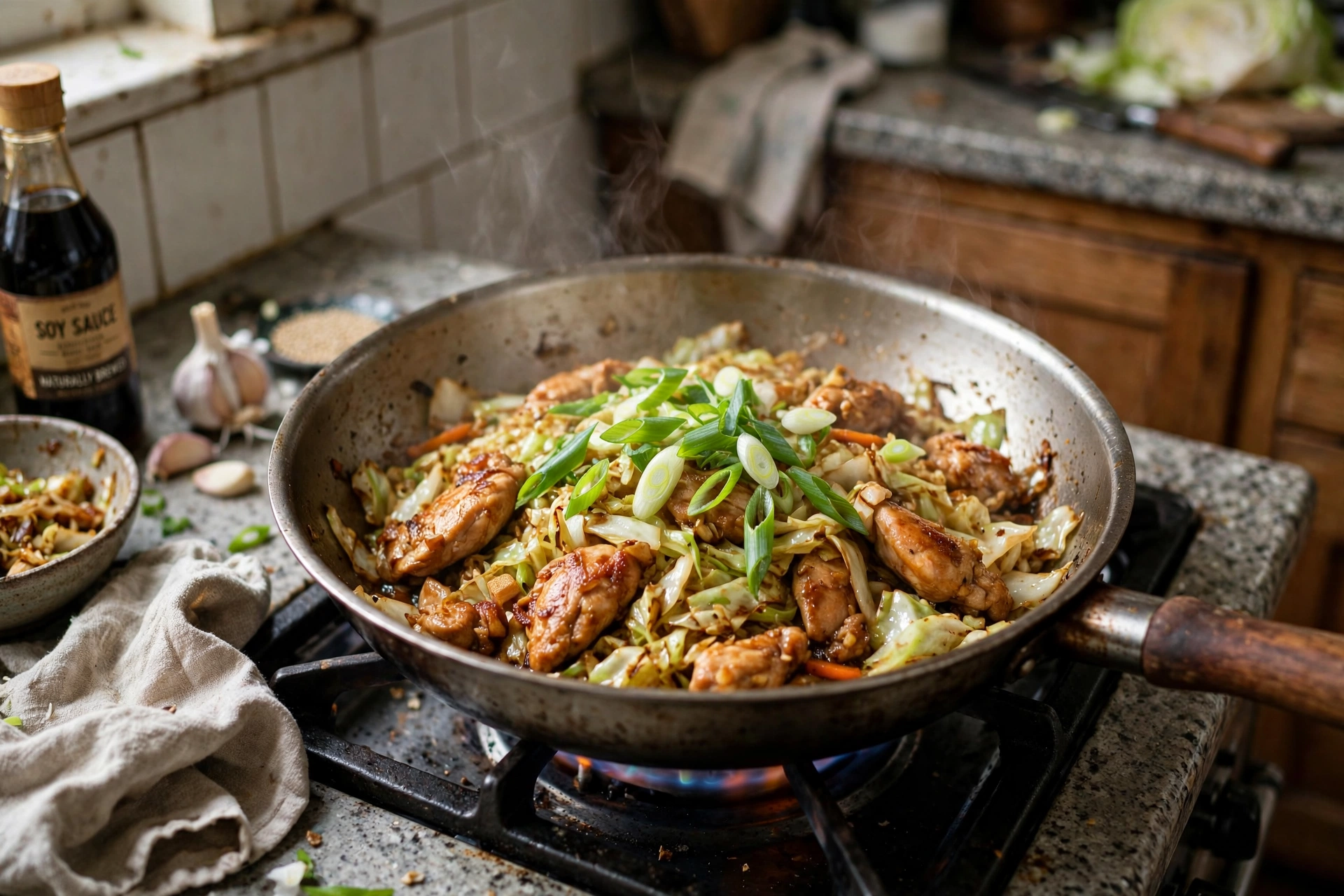
Warm it back up in a frying pan — an actual pan, on the hob, with a bit of ceremony about it, not the microwave, however loudly the microwave offers its services. Medium-high heat, a teaspoon of oil sloshed in first, and 3 to 4 minutes of keeping the whole lot moving, tossing and turning it over itself, until it’s steaming properly and the cabbage edges start catching again, just slightly, the way they did on the first night. The microwave works — 2 to 3 minutes, stirred halfway — but it steams everything and the texture pays. Pan if you can.
Freezer: I don’t, as a rule. Cooked cabbage freezes like a grudge — it thaws limp and watery and no hot-pan optimism revives it. If you must, it keeps a month and still tastes fine; it just won’t have the bite, and the bite was rather the point.
Better plan: freeze nothing; take the extra portion over the road while it’s still hot. Mrs. Okafor, who calls the first attempt “the incident” and this one “the cabbage one, the proper one,” accepts deliveries on all days ending in y.
A Last Word
Make it on the Tuesday when you open the fridge door and it looks back at you more or less empty, when the week already feels too long and it is only — well. Tuesday. Make it when the vegetable drawer holds one stubborn cabbage and very little else. Make it to prove a point to a vegetable that has been underestimated in your house for years.
Some dinners are just food. Others clear their throat, get the pan smoking, and remind everybody at the table that a cabbage — treated hot, fast and with respect — was never the problem. The problem was the soup. We don’t make the soup anymore.
