
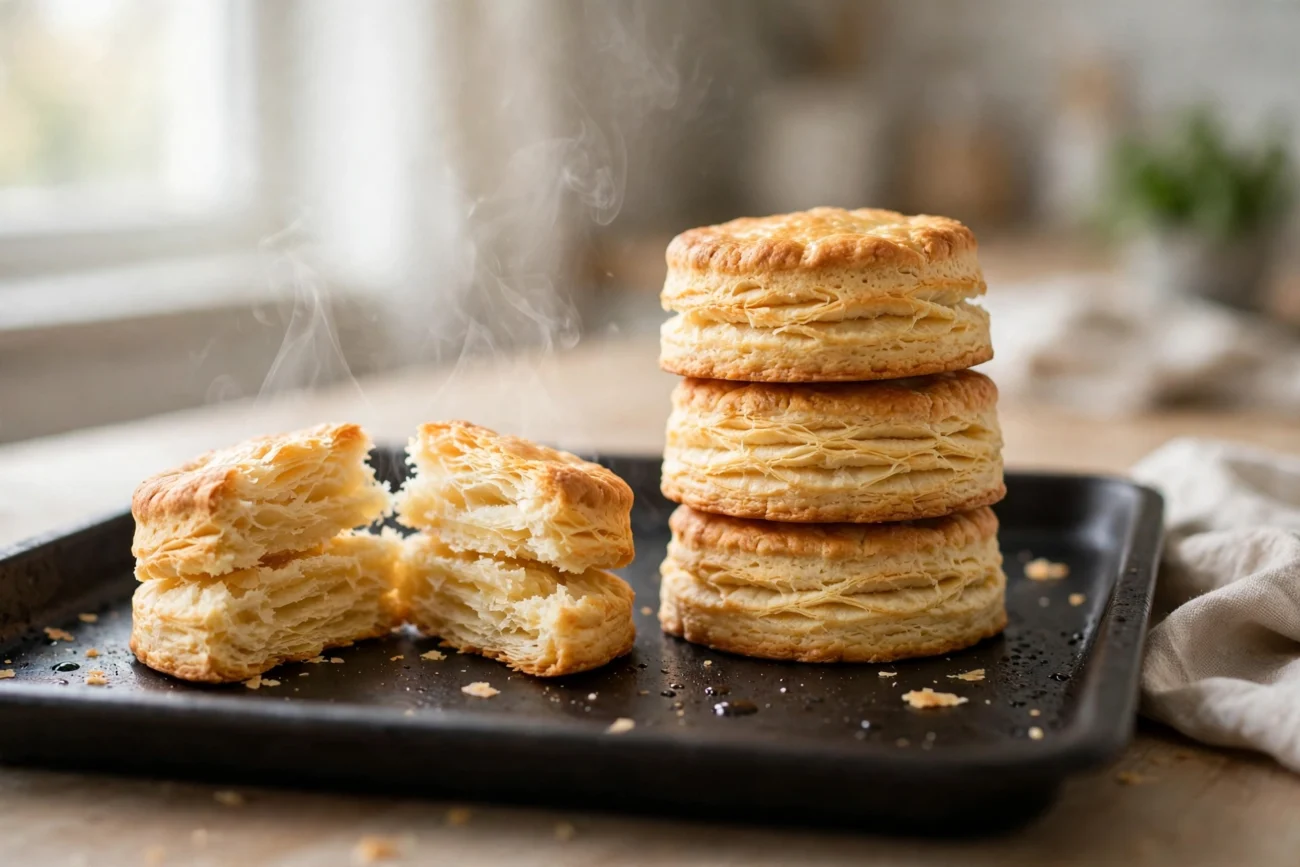
Nobody tells you a biscuit can make a noise. Mine did. A dull little clunk against the plate. More roof tile than breakfast.
I stood there holding a tray of eight pale discs. Discs I had measured. Followed instructions for. Believed in.
My daughter was six. She took one in both hands, like a stone at the beach. Weighed it.
Set it down gently. Then she informed the table that breakfast was heavy today.
Heavy. That was the whole review.
Eleven trays later, this house makes biscuits that tear open in layers. Steam coming out. My cousin Nadia takes two before anyone sits down.
But it was never talent. Every failed batch failed for one of three boring reasons. All fixable.
And the worst offender? Something I still watch people do in their own videos. I have to sit on my hands about it.
Autopsy first. Then biscuits.
Why they go dense, which is fixable
A wheat biscuit climbs because of the gluten — that stretchy net stuff does quiet scaffolding work in there, holding the layers apart so they puff instead of slumping into each other (I have produced the slumped version; it fed nobody but the bin). Take the wheat away and the scaffolding goes out the door with it — which is how you end up serving the heavy breakfast my daughter reviewed so kindly.
The flour blend itself
So ours comes from the flour blend itself. A proper 1:1 gluten free blend, xanthan gum already in it.
Xanthan binds. Gives the crumb a little stretch — not much, just enough that a torn biscuit pulls a bit instead of snapping clean like a cracker. And it props the little steam pockets open, holds them up like tent poles, until the biscuit has set around them and can’t cave in on itself.
Read your bag first. No xanthan listed? Whisk three quarters of a teaspoon in yourself. Skipping it is a detour back to the clunk.
Then the big one: warm butter.
Layers are smuggled in
Layers are not mixed into a biscuit. They are smuggled in. Flat pieces of cold butter, trapped between sheets of dough. In a hot oven they turn to steam and shove the sheets apart.
That shove is the entire rise.
Soft butter cannot be trapped. It coats the flour. And coated flour bakes into a dense, greasy disc, however good your intentions were.
So the butter goes in cold. Cubed. Frozen fifteen minutes in this house — because room temperature has lied to me before.
And the dough will look like a mistake. Shaggy. Rough. Half convinced it is falling apart.
Your hands will want to knead it respectable. Talk them down. Work gluten free dough smooth and the starches smear into paste. Your layers merge into one lump.
Shaggy is not a stage on the way to correct. Shaggy is correct.
What goes in
Eight tall biscuits from this, nine if your cutter is small and behaving. Twenty minutes of prep, fifteen resting, fourteen to sixteen baking — fifty minutes all in, most of it temperature doing the work.
- 300 g (2½ cups) 1:1 gluten free flour blend — the kind with xanthan gum already in it, check the bag
- ¾ tsp xanthan gum — only if your blend leaves it out, most don’t
- 1 tbsp baking powder — check it still fizzes, old powder is a silent killer
- ¼ tsp baking soda — small amount, big opinions
- 1 tbsp sugar — not for sweetness, for browning and tenderness, put it in
- 1 tsp fine salt — non negotiable
- 115 g (½ cup, 1 stick) unsalted butter — cubed and frozen fifteen minutes, the diva of this recipe
- 180 ml (¾ cup) cold buttermilk — plus 1 to 2 tbsp more only if the dough demands it, plus a splash for brushing the tops
- 1 tbsp melted butter — for brushing when they come out, the finishing move
The method, as it actually happens here
- Oven on. First. 220 degrees Celsius, 425 Fahrenheit, rack in the middle, properly hot before anything else happens, because cold dough in a half-hearted oven just sits there leaking butter, and leaked butter is a layer that never happened.
- Everything dry into the biggest bowl you own — flour blend, baking powder, soda, sugar, salt — and whisk a full twenty seconds like you mean it. Fussy, yes. Until you remember batch four. The powder stayed in pockets. One heroic biscuit rose like a soufflé while three neighbours sat at tray level, refusing to participate. Even distribution is dull. It is also the whole game.
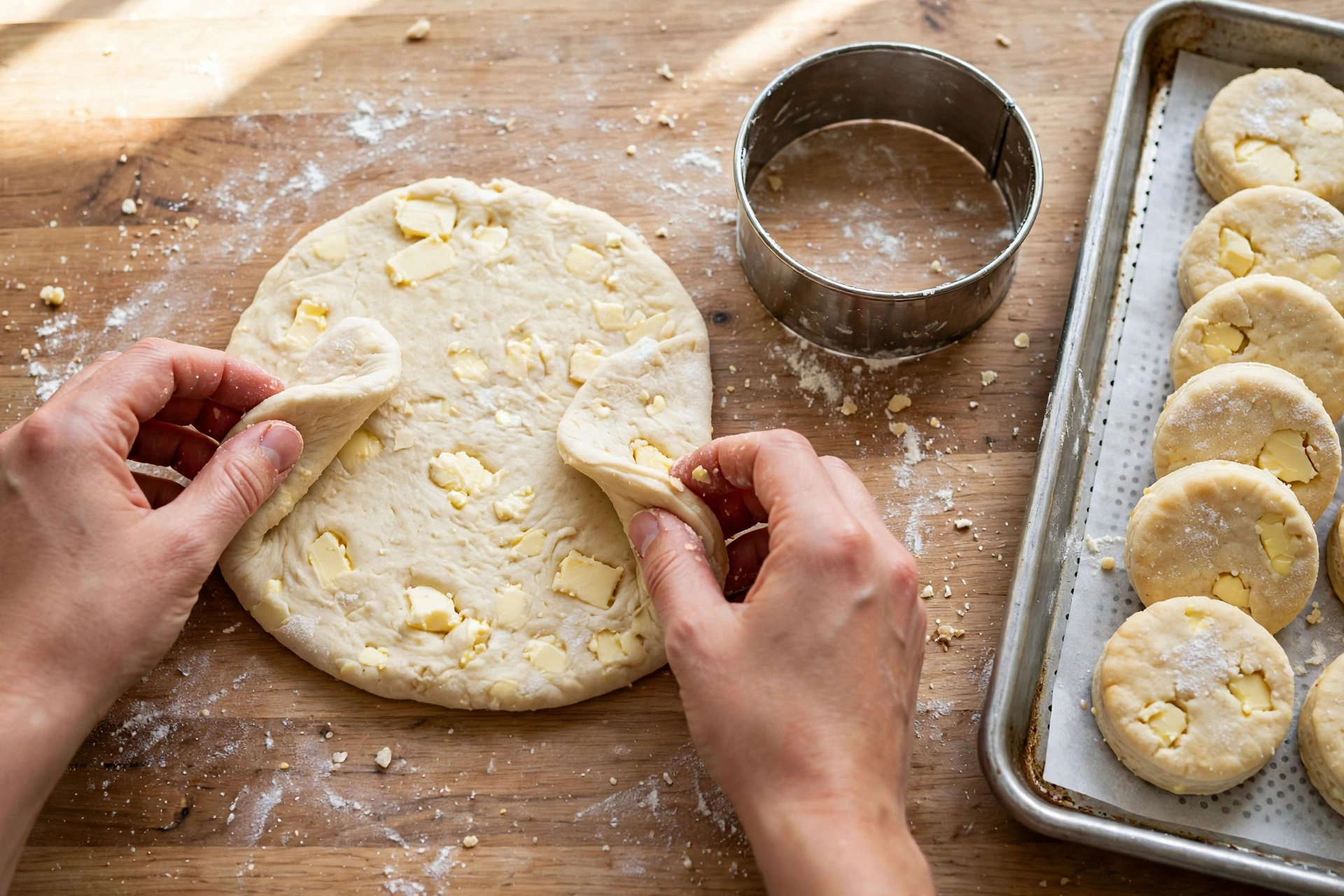
- Butter now, and no dawdling about it — the cubes go in frozen solid, straight from their fifteen minutes, and I get them cut in fast with the pastry cutter, or two knives crossed over each other, the way my mum did it before pastry cutters were a thing anybody in our street owned. Biggest pieces pea sized. Some smaller. And some — these are the ones you want — squashed flat into little shards. A shard melts into a layer. A lump just melts. Stop while butter is still visible everywhere. Uniform sand means you have gone too far.
- Cold buttermilk over the top, and a fork. Stir just until the dry flour at the bottom gives up. Fifteen stirs. Twenty tops. Squeeze a handful. Clumps? Done. Crumbles? One more tablespoon — two at the very most — and squeeze again before even thinking about a third. A wet dough does not climb. It spreads. And spreading is a pancake’s business.
- Counter time. Lightest dusting of the same blend or rice flour. Pat — never roll, a rolling pin is a layer-destroying argument I am not having again — the dough out to a rough rectangle. About two and a half centimetres thick. One inch. Fold it in thirds like a letter — thirds, mind, the way my mum folded the electricity bill before it went back in the drawer. Quarter turn. Pat it back out. Four times total. Fold one fights you; fold three behaves like it always knew the plan. And if your fingertips start coming away greasy, stop. Mid-whatever. Fridge, ten minutes. Butter temperature outranks your schedule.
- Cutting is where past me suffered. Pat the dough out once more. Flour a seven centimetre cutter — two and three quarter inches — and press straight down. Lift straight up. Down. Up. Nothing in between. Twisting, which I did for years out of plain cookie-cutting habit, seals the layers shut. Like the glued seam of an envelope. And a sealed biscuit cannot climb. Press the scraps together once, cut the rest, accept the wonky last ones. Those are the family’s.
- Tray them touching shoulders. Like passengers under one umbrella. Touching biscuits borrow each other’s heat — they rise taller, keep soft sides. Biscuits given personal space spread and firm up, like they are trying to be scones. Then the step everyone skips: the tray rests fifteen minutes in the fridge while the oven finishes. Cold dough, hot oven. That shock is your last bit of steam lift insurance. Take it.
- Brush the tops only with a little buttermilk. Never the sides — we do not paint the escape routes shut. In they go, fourteen to sixteen minutes, and watch the colour, not the clock. Deep gold. A pale biscuit is an underbaked biscuit, and underbaked gluten free anything is gummy in the middle. Law of the starch.
- Straight out, brush the tops with the melted butter while they are hot. Then wait five minutes. Five. You can do five. Then eat one standing at the counter, steam in your face. Cook’s tax. It is in the contract. My daughter — the original heavy-breakfast critic — now claims seniority over this step. She has earned it.
The batch that went wrong, so yours does not
Batch seven. For guests, obviously. It is always for guests.
I had cubed the butter. Was feeling ahead of myself. Then the phone rang. Twenty minutes of family logistics happened while the butter sat out, getting comfortable.
I knew, too. Said it out loud to an empty kitchen: that butter is too soft. Baked them anyway. Why do we do this.
They spread into flat, greasy-edged discs. No layers. A chew that outlasted the flavour. My brother-in-law, a diplomatic man, chewed thoughtfully and called them very filling, which remains the most polite biscuit review in recorded history.
The fix is boring and total. The moment butter softens anywhere in the process: stop. Refrigerate the dough fifteen minutes.
Carry on. Biscuits wait happily in the fridge. Butter does not forgive.
Still dense? Work the suspects in order. Dead baking powder — test it, a spoonful in hot water, it should fizz angrily. A blend with no xanthan after all.
And your own hands. Hand on heart. Twisting the cutter.
Two ways we actually eat them
Cheese biscuits
Cheese biscuits, for soup and chilli nights. Fold the cheddar in with the butter at step three — 75 grams of it, finely grated sharp cheddar, weighed on the little scale that lives next to the kettle. If you’re measuring by cup, that’s about three quarters of a cup — loosely packed, not rammed down with the back of a spoon the way my brother-in-law does everything. And paprika, just a pinch of it, from the jar with the faded label — more for colour than for courage.
Finely grated is the whole point here — not thick shreds, not the bagged stuff that comes out looking like orange shoelaces. Thick shreds melt straight out and leave cheese tunnels behind. Which sounds fun. Is, briefly.
Then the layers slump. Fine gratings melt into the layers instead. Nadia has eaten four in one sitting before now, so nobody in this house needs convincing.
Drop biscuits
Then there are drop biscuits, for the mornings — you know the ones, alarm ignored twice, hair doing its own thing — when folding anything in thirds is simply not happening. Those mornings the buttermilk goes in heavier — two extra tablespoons of it, the first stirred through, a pause while you look at what you’ve got, then the second — and you keep at it until the dough stops arguing with the spoon and slumps a bit, loosened up, given in. Thick is the word. Scoopable thick.
The dollop should sit up on the spoon like it’s considering its options, slide maybe a fraction, then think better of it and stay put. Skip the folds.
Drop eight rough mounds onto the tray with two spoons. No layers to speak of. Soft, golden, faster. Under jam, nobody here has ever filed a complaint.

Keeping them, and the next day trick
Fresh is best, full stop — my brother-in-law once ate one in the car before he’d even reversed out of the drive, which tells you everything. They’re at their peak inside the first hour, still lovely the same day if you’re sensible about it, and after that the crumb firms up — it just does, the way gluten free crumb always does, like it remembers being powder. Keep them airtight at room temperature — ours live in the tub with the blue lid: a day. Two at a push.
Reheat them properly, though — a cold leftover biscuit eaten in silence, standing in front of the open fridge at 11pm, is a small tragedy, and it’s one a warm oven could have prevented entirely. Five minutes at 160 degrees, 325 Fahrenheit, does it — and actually set the timer, because “I’ll just remember” is a lie we all tell. Or split and toasted, cut side up. Edges crisp again, middle soft again.
Freezing is where they quietly shine. Baked and cooled, bagged, good for two months. From frozen they reheat at 160 degrees, about twelve minutes — straight in, no defrosting faff, while you put the kettle on and pretend you planned it. Or skip the baking altogether and freeze the cut, unbaked rounds on a tray, spread out not touching, like passengers who’ve had an argument. Bag them once solid.
Bake from frozen with three or four extra minutes. Past you makes some excellent decisions. Occasionally.
So: cube the butter tonight. Freeze it. Future you, in a warm kitchen tomorrow — cold butter, hot oven — is going to be unbearable.
And when your own no-filter person picks one up and cannot find a single heavy word to say? That is the test. That is the whole test.
